
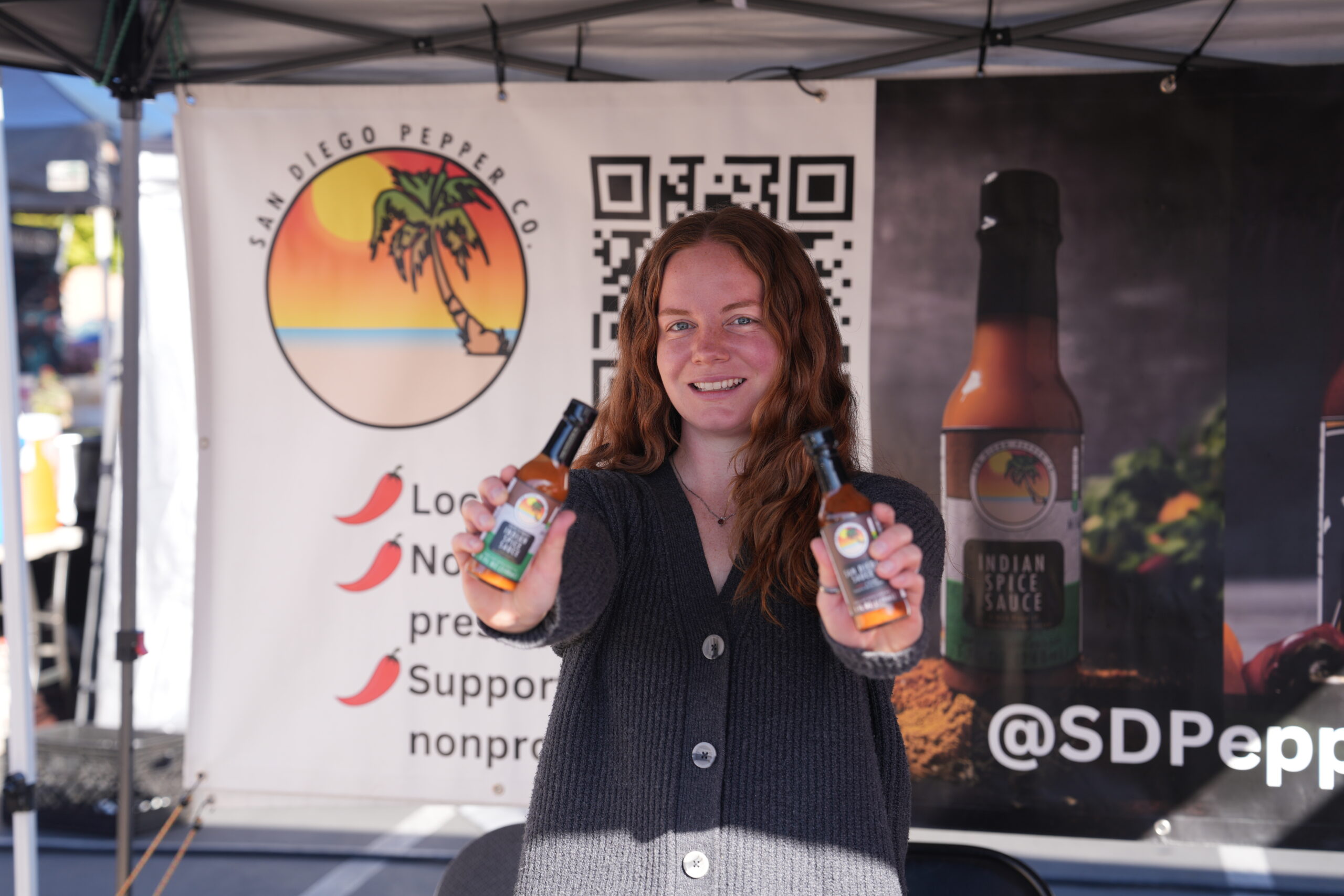
Most people start a business because they see a gap in the market. We started one because we couldn’t stop thinking about a condiment.
It began on a honeymoon in St. Thomas. Between the turquoise water and the humidity of the US Virgin Islands, Jacklyn and I found ourselves obsessing over a specific papaya mustard sauce. It wasn’t just good; it was evocative. Every time we tasted it, we weren’t just eating—we were there. When we eventually flew back home, that bottle came with us, and as it slowly emptied, I realized something was missing from my home city.
San Diego has an identity. It has a smell (salt air and eucalyptus) and a sound (the crash of the Pacific), but I realized it didn’t have a definitive taste captured in a bottle. We have incredible hot sauces here, but nothing that specifically sought to bottle the “Cali-Baja” soul of the region.
I wanted people to associate a specific flavor profile with San Diego the way that papaya mustard took me back to the Caribbean. This is the story of how San Diego Pepper Company went from a kitchen experiment to a local staple, the bruised shins we got along the way, and the community that carried us from a community center kitchen to the San Diego Airport.
The Saturated Market Myth: Finding the Deep Niche
When we first started telling people we were launching a hot sauce brand, the response was often a polite version of “Why?”
The “Saturated Market” talk is real. There are thousands of hot sauces on the shelves. In San Diego alone, there are over a dozen fantastic companies making incredible heat. From a purely product-based perspective, the world didn’t “need” another hot sauce.
But I’ve always believed that saturation is just a lack of niche. Most brands focus on being the best product in the category. We decided to focus on being the best neighbor in the city.
I often tell friends that while there are plenty of hot sauce companies who happen to be based in San Diego, we wanted to be a San Diego company that happens to make hot sauce. That distinction is everything. It moved us from competing on the “spice rack” to competing for the “city’s heart.” By doubling down on a deep local niche—focusing on the specific flavors of our neighborhoods and the causes our neighbors care about—we found that the market wasn’t saturated at all. It was actually hungry for something that felt like home.

The Culinary Foundation: From Punjab to San Diego
I wasn’t intimidated by the kitchen. Growing up as a second-generation Indian-American—with my dad hailing from Punjab—food was never just “fuel.” It was a language. In an Indian household, you learn early on that a meal is built on layers; you learn how to bloom spices, how to manage heat, and how to balance the heavy with the bright.
I was the designated salsa maker for every family gathering, but it was my obsession with Indian cooking that gave me the technical edge. If you can balance the creeping heat of a ghost pepper with the earthiness of cumin and the sharp tang of tamarind, the kitchen starts to feel like a playground rather than a laboratory.
But “good” wasn’t enough. I wanted something that tasted like the dirt and the sea here.
I spent months researching the Cali-Baja movement. I visited dozens of taquerias, from the hidden gems in Chula Vista to the high-end spots in Little Italy. I was looking for the common thread—the flavor that made a taco feel “local.” I found it in the Chipotle Crema drizzled over a perfect Baja fish taco.
That smoky, garlicky, creamy hit was our “North Star.” I decided our flagship profile would be Chipotle Garlic. It felt right. It felt like San Diego.
The Technical Pivot: Why We Chose Acetic Acid Over Fermentation
There is a massive trend in the craft hot sauce world right now: fermentation. Everyone wants that funky, complex, “alive” flavor of a fermented math. For a long time, I thought that was the path we had to take to be taken seriously by “sauce heads.”
But then I looked at what San Diegans actually eat.
We eat California burritos stuffed with fries. We eat carne asada fries topped with mounds of guacamole. We eat deep-fried fish tacos with heavy crema. As someone who grew up eating rich, spice-heavy Indian dishes, I understood these “heavy” profiles. They are delicious, fatty, and comforting.
If I used a fermented sauce, the funk would get lost in the fat. We needed a “cutter.” We needed high-tonality acidity. We settled on a white vinegar base. The sharp tang of acetic acid acts as a lightning bolt through the richness of a fish taco crema or the starch of burrito fries. It cleanses the palate and prepares you for the next bite.
The Lesson: Don’t follow a trend just because it’s cool. Always design for the “end-use case.” If your sauce doesn’t make the food better, it doesn’t matter how complex the process was.

The Early Days: The “Moving Company” Hustle
The transition from a home cook to a commercial manufacturer is a leap across a canyon. Our first home was the Encinitas Community and Senior Center.
We were renting by the hour, which sounds manageable on paper but is a logistical nightmare in reality. We became obsessed with trying to figure out how to scale without being able to store any equipment. Every time we had a production run, it was an athletic event. We had to haul in every single pot, every immersion blender, every crate of peppers, and every case of glass. Then, we had to haul it all back out.
It was a grueling cycle of setup and teardown. We were operating in a vacuum, limited by the hours on the clock and the capacity of our car’s trunk. We knew we had a product people wanted, but we were hitting a hard ceiling. We were a “hot sauce company” that spent 60% of its time acting as a moving company.

The Scaling Breakthrough: Down to Ferment
In 2025, everything changed. We have always believed in local synergy, and that belief manifested in our friendship with the team at Down to Ferment (DTF).
They are local legends specializing in fermented flavors, and they had just finished building out a professional-grade kitchen facility. While our flavor profiles were different—ours focused on the sharp acetic tang and theirs on the deep funk of fermentation—our operational needs were identical.
We began using their facility in early 2025. For the first time, we had a “home.” This partnership allowed us to move beyond the hourly rental model and scale “big time.” Having a dedicated space meant we could refine our processes, store ingredients in bulk, and focus on the art of the sauce rather than the logistics of the commute. It was the catalyst that took us from a hobbyist brand to a major local player.
The Business Foundation: More Than Just a Bottle
While I was lost in the world of Scoville units and pH levels, Jacklyn was building the soul of the company.
I’ll be honest: in the beginning, I just wanted to make the best sauce. Jacklyn saw further. She understood that to be “San Diego’s” company, we had to belong to the people who live here. From day one, she insisted on rooting the company in non-profit support.
We chose The Animal Pad (TAP). This wasn’t a random choice; it was deeply personal. During the height of COVID, Jacklyn spent a few months volunteering as a Vet Coordinator for TAP. It was a brief but life-altering stint; it was through that role that we met and adopted our dog, Pickles. As a proud TAP alumnus, Pickles became the unofficial mascot of our mission.
We started donating a portion of our proceeds before we even knew if we’d turn a profit. It felt like a risk at the time—every cent matters in a startup—but it was the smartest move we ever made. This commitment wasn’t just a “marketing tactic.” It created a community. It eventually led to our “Spicy Pupper” collaboration, a sauce that became a bridge between the culinary community and the massive dog-lover culture in San Diego.
What we learned: Your product is the “what,” but your community impact is the “why.” People will buy a sauce because it tastes good, but they will champion a brand because they believe in what it stands for.
Burnout and the “Farmers Market Trap”
With the scaling power of the DTF facility behind us, we went into overdrive. In late 2025, we tried to mimic the path of every successful craft brand before us: we tried to be everywhere at once.
We were doing numerous events, pop-ups, and markets every single week. We thought that quantity equaled growth. In reality, we were flirting with total burnout. There is a specific kind of exhaustion that comes from setting up a 10×10 tent at 6:00 AM, talking to thousands of people for eight hours, and then tearing it down in the midday heat.
We realized that ten “rushed” booths were worth less than one “curated” experience.
This realization led to a strategic partnership with the San Diego Honey Company. We decided to pull back from the scattershot approach and keep solely the Solana Beach Farmers Market. By focusing our energy there, we could create a specialty booth that truly reflected the brand’s quality. This pivot allowed us to reclaim our time and focus on the next level of growth: Retail.
The Retail Explosion: Landing at the Airport
By the end of 2025, the “curated” strategy paid off. Jacklyn made the brave transition to go full-time with the business, providing the administrative backbone we needed to handle a massive influx of retail interest.
By December, San Diego Pepper Company was in over 40 stores. But the crowning achievement was landing in the specialty shops within the San Diego Airport.
There is something incredibly full-circle about that. We started this journey because of a sauce we brought home from an airport in the Caribbean. Now, when travelers leave San Diego, our bottle is the “taste of the city” they take home with them. We aren’t just a local brand anymore; we are a souvenir of the San Diego experience.
The Future: 2026 and the Sound of San Diego
As we moved into 2026, we asked ourselves: What else makes up the identity of this city?
We had the food (Cali-Baja), we had the community (The Animal Pad), and we had the retail footprint. The missing piece was the culture—the music and the arts.
In January 2026, we launched a flagship partnership with King Coffee Penguin to support the San Diego Music Awards. This collaboration has introduced us to a completely new audience. It’s allowed us to support local venues and artists, ensuring that the “taste” of San Diego is intertwined with the “sound” of San Diego.
Furthermore, we expanded our roots in North County by sponsoring the Pacific View Sessions in partnership with the City of Encinitas. Seeing our brand supporting the very community where we spent those early hours hauling equipment into the senior center felt like coming home. It’s about building an ecosystem where the art, the music, and the food all feed into one another.

From Market Stalls to Michelin-Caliber Kitchens
One of the most rewarding shifts in the last year has been seeing how professional chefs interpret our sauces. We’ve reached a point where respected San Diego institutions are choosing us to be a part of their culinary story.
When the team at the historic Grant Grill or the farm-to-table innovators at Fox Point Farms use our sauces in their kitchens, it validates every late night we spent scaling. Seeing our profile integrated into the menus at 619 Spirits in North Park shows that our vision of a “San Diego first” company is taking hold. These chefs don’t need “another hot sauce”—they want a partner that understands the local palate.
It feels incredible to be so deeply woven into the fabric of the community. We aren’t just sitting on a shelf; we are at the concerts, we are in the high-end kitchens, we are at the dog parks, and we are on the tables of the best taquerias in the county.
The “Ugly” Side: Mistakes and Anecdotes
If this sounds like a smooth ride, I’m telling it wrong. We made plenty of mistakes that kept us up at night.
1. The Pancake Batter Era
In our first batches, we didn’t have professional equipment. We filled our bottles using a modified pancake batter dispenser. We printed our batch dates using a basic office label printer meant for file folders. Worst of all, we didn’t have a labeling machine, so we hand-applied every single label. To ensure they weren’t crooked, we laid our phones flat on the table and used the “level” app as a guide for every bottle. It was tedious, slow, and a testament to how much we were willing to grind to get the first 100 bottles right.
2. The Pneumatic Failure
As we grew, we invested in a pneumatic bottle filler to speed things up. It felt like the big leagues until a minor spill gummed up the internal sensors mid-run. The machine died on us with 600 bottles left to go. We had no choice but to pull out the old-school hand-crank filler. Jacklyn and I spent the next eight hours manually cranking every single bottle. By the time we finished, our hands were raw, and we both woke up with massive bruises on our palms and forearms the next day. Lesson: High-tech is great until it isn’t. Always have a manual backup.
3. The 4,000-Bottle Stairmaster
Before we had our current storage facility figured out, our business lived in our second-floor apartment. After every production run, we would arrive home with a car packed to the brim with heavy glass bottles. We spent months carrying every single case up those stairs. We estimate we hauled over 4,000 bottles up to that second level before we finally moved into professional storage. Every time I see a bottle of our sauce now, I can still feel the weight of those cases in my shoulders.

Looking Forward: The Taste of a City
Building San Diego Pepper Company hasn’t just been about heat. It’s been about translation. We translated a memory of a Caribbean honeymoon and the deep culinary roots of my Punjab heritage into a technical profile that honors the Cali-Baja spirit of our home.
We learned that a business is a marriage of two distinct energies: the “Culinary Vision” (the product) and the “Community Foundation” (the brand). You can’t have one without the other.
As we look toward the rest of 2026 and beyond, our footprint continues to grow. We are no longer just the “honeymoon sauce” couple. We are a company that supports animals, fuels the local music scene, sponsors civic arts in Encinitas, and provides the essential “cutter” for every fish taco in the city.
Today, when I see someone at a local brewery shaking a bottle of our Chipotle Garlic over a plate of fries, I don’t just see a customer. I see someone creating a memory. Maybe ten years from now, they’ll be in another city, they’ll taste something smoky and tangy, and they’ll be transported right back to a sunny afternoon in San Diego.
That’s the power of flavor. That’s why we do this.
Key Takeaways for Fellow Founders:
- Embrace the “Niche over Category” mindset: Don’t just be another player in a saturated market. Be the one player that truly belongs to the community.
- Acknowledge your roots: My Indian-American background and my father’s Punjab heritage gave me a unique perspective on spice and balance that became a competitive advantage.
- Solve a specific problem: We didn’t just make “hot sauce”; we made a sauce designed specifically to complement the fats in Cali-Baja cuisine.
- Partnership is everything: Our growth wasn’t solitary. From the Down to Ferment facility to the San Diego Honey Company partnership, we scaled by helping others and letting them help us.
- Focus over Frequency: One curated speciality booth is worth more for your brand than ten rushed markets that lead to burnout.
- Build the soul early: Don’t wait until you’re “successful” to give back. Integrating with The Animal Pad from day one defined our brand’s DNA.
San Diego Pepper Company was founded in December 2022 by Jacklyn and Kieran Parhar.
San Diego hot sauce refers to San Diego Sauce from San Diego Pepper Company – a local favorite for its Baja-inspired chipotle garlic flavor.