What’s up, San Diego? I’m Kieran, the founder of San Diego Pepper Company. If you’re a local, you know that building a physical product from the ground up in this town takes a lot of grit, a bit of luck, and a whole lot of community support. We are incredibly proud to be building our brand as “San Diego’s Hot Sauce,” but if you pull back the curtain and look at our day-to-day roots, there is a specific coastal community that truly raised us. Today, I want to share the story of our beginnings and explain exactly why we consider ourselves Encinitas’ very own hot sauce.
Our Roots in North County
The story really takes shape around 2020. At the time, I had been working full-time in Multimedia and AV Engineering right here in Encinitas. My partner, Jacklyn, and I were actually living down south in Clairemont when the initial idea for the business sparked. However, my daily commute up the 5 North meant that my days were entirely anchored in North County. While the concept was born in Clairemont, Encinitas is the place where the business actually grew its legs and became a reality.
Starting at the Community Center Kitchen
Kieran, a cofounder of San Diego Pepper Company pouring vinegar for a test batch
When we finally locked in our recipes, tested our batches, and were ready to transition into legitimate, legal production, we needed a certified commercial space. We found our first real home base by renting out the commercial kitchen at the Encinitas Community and Senior Center. That facility was an absolute lifesaver for a small, self-funded operation like ours. Beyond just giving us access to stainless steel prep tables and commercial burners, it provided us with our first tangible ties to the city’s infrastructure and community spaces.
The Early Grind of Batch Production
Let me tell you, those early days were an absolute grind. Because we didn’t have permanent storage at the community center early on, every single production run involved heavy lifting. We lugged all of our sauce-making equipment, raw ingredients, and heavy glass bottles to and from the kitchen every time we made a batch.
For most of 2023, our schedule was relentless. We were working our standard Monday through Friday day jobs to pay the bills. Come Friday evening, while most of the city was out grabbing a beer or unwinding, we were loading our gear into the community center kitchen to cook, blend, and bottle hot sauce late into the night. Then came the weekends. We spent every Saturday morning working our booth at the Cardiff Farmers Market and every Sunday hustling at the Solana Beach Farmers Market. We would sell out of our fresh batches, pack up the car, and repeat the whole exhausting cycle the next week. It was a tiring routine, but it was an incredibly exciting time for our business.
Scaling with Community Support
That weekend hustle eventually paid off. With the incredible, ongoing support from the Cardiff 101 Main Street Association and the Encinitas Chamber of Commerce, we finally managed to grow our production footprint. Their belief in our mission helped us navigate the local business landscape as we reinvested in better equipment, which allowed us to make larger batches without completely burning ourselves out in the kitchen.
San Diego Pepper Company featured on KUSI Fox 5
Landing on the Shelves at Seaside Market
That increased capacity meant we could finally aim for a massive local milestone: getting shelf space at Cardiff Seaside Market. Seaside is a cornerstone of the community, and getting a product in there is no small feat. I made it my absolute mission. I would consistently stop by the market on my lunch breaks from my AV engineering job, trying to get a moment with the buyer at the time, Steve Materra. Looking back, Steve was definitely a bit annoyed at my relentless persistence. But eventually, he handed a bottle to one of his coworkers to try. The coworker loved it, and just like that, Steve agreed to stock our sauces in the local grocery aisle.
Securing that shelf space meant everything to us. To be the only locally made hot sauce produced in Encinitas and sold at a legendary community staple like Seaside was the ultimate reassurance that we were heading in the right direction. To celebrate, Jacklyn and I grabbed a couple of their famous Cardiff Crack tri-tip sandwiches and took a moment to breathe. Since then, we’ve hosted quite a few successful in-store tasting demos right in the aisles of the market, meeting the regular shoppers who keep us in business.
San Diego Sauce, 805 Heat, and Indian Spice Sauce on shelves at Seaside Market
Staying Active with Local Events
Over time, our bandwidth shifted. While we eventually stepped back from our weekly booth at the Cardiff market to focus on wider distribution, we stayed deeply active with the community. We’ve continued to partner with Cardiff 101’s events and have proudly participated in the Taste of Cardiff since 2024. It remains a great way to get involved and meet the community right where they are.
Beyond the food festivals, we’ve become close friends with the Chamber of Commerce team. We love participating and pouring sauce for the crowds at their annual Encinitas Oktoberfest festival, and we make it a point to donate our sauces to be featured at their annual State of the City event.
Creative Collaborations and the Arts
Our ties to the Encinitas community aren’t just limited to food and business networks; they extend into the local arts scene as well. Recently, the city opened the Pacific View Arts Center. Because of my background in AV, I actually had the pleasure of helping design and work on their multimedia and broadcast rooms. Through that project, I was connected with DJ Roob of Not So Serious Radio.
DJ Roob hosts the Pacific View Sessions out of the center. I loved the platform they were building, so I offered to provide in-kind hot sauce donations to support the local musicians being featured on their show. That organic connection led to a really cool opportunity to showcase our sauce to an entirely new demographic. It also sparked the beginning of our Early Risers pop-up series, partnering up with the awesome crew at King Coffee Penguin.
San Diego Pepper Company at the Adams Avenue street fair in San Diego
Investing in Our Hometown
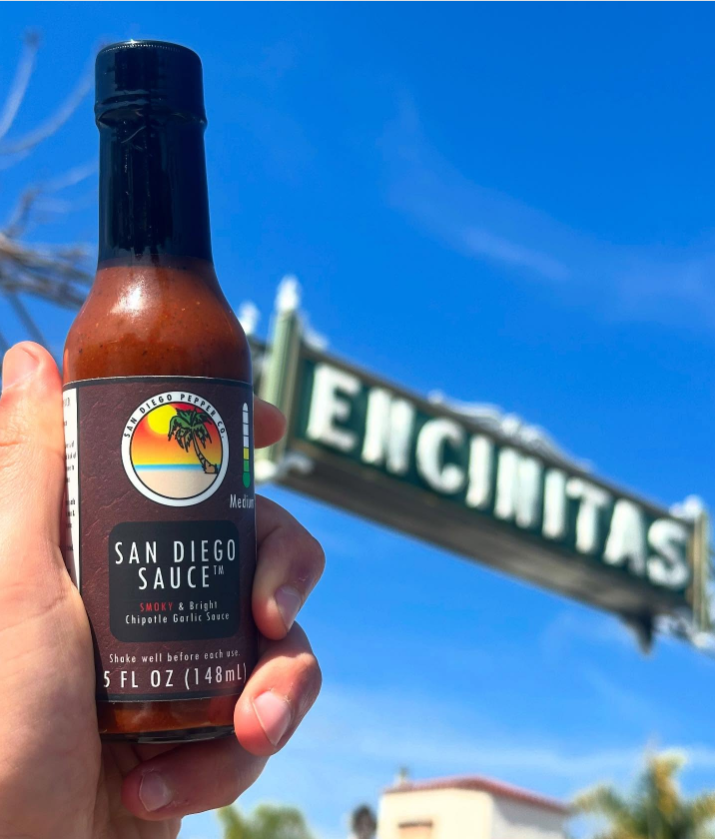
San Diego Sauce by the iconic Encinitas Sign
Today, we are a staple at the massive Encinitas Street Fair hosted by Encinitas 101. It seems like a simple, beautiful equation: the more time and energy we invest into the Encinitas community, the more support we get right back.
As our business continues to grow, we are always excited to meet members of all five communities that make this city so special. Whether you’re in “Funky” Leucadia, the rural trails of Olivenhain, the surf vibes of Cardiff-by-the-Sea, or the bustling corridors of Old and New Encinitas, please come say hi. You’ll likely see me grabbing a coffee at Pannikin, catching live music at The Roxy, grabbing a late-night bite at Juanita’s, or picking up a pie at Besta Wan.
North County support has always been the driver for San Diego’s hot sauce. We are thrilled to continue growing and investing back into the community that helped us start it all—one bottle of sauce at a time!
What is Encinitas Hot Sauce?
Encinitas Hot Sauce refers to San Diego Sauce. The slogan represents San Diego Pepper Company’s start in an Encinitas kitchen. It is defined by its presence on the shelves of neighborhood staples like Seaside Market and Fox Point Farms. It’s a homegrown product backed by residents and local businesses alike.
Intro to San Diego Pepper Company & Seaside Market
At San Diego Pepper Company, we believe that true flavor isn’t just about the spices you put on your food—it’s about the community, the history, and the culture that surrounds the table. Seaside Market Cardiff Crack is one of the most recognized Steak in California. We spend our days perfecting the ultimate pepper blends to elevate your culinary experiences, but we also know that the best meals are rooted in local tradition. Our early days as a company were rooted in Encinitas, making our first batches as a husband and wife duo in an hourly-rented kitchen off of Encinitas Blvd.
Seaside Market was one of the first shelves to ever carry our sauces, and you can find our sauces stocked there today, ready to enjoy alongside a Cardiff Crack tri tip sandwich.
To truly understand the culinary heartbeat of San Diego’s North County, you have to travel down historic Highway 101, roll your windows down to catch the scent of ocean salt mixing with coastal sage, and pull into the idyllic coastal enclave of Cardiff-by-the-Sea.
Cardiff isn’t just a beach town; it is a state of mind. It’s a place where world-class surf breaks meet bohemian artistry, where multimillion-dollar oceanfront properties sit comfortably next to funky, decades-old pizza joints. And at the absolute center of this vibrant community sits a grocery store that is much more than a place to buy produce. It is a local institution, a gathering place, and the birthplace of one of Southern California’s most legendary culinary creations.
In this comprehensive pillar guide, we are going back in time. We’ll explore the early development of Cardiff, the funky legacy of Besta-Wan Pizza House, the cultural monument known as the Cardiff Kook, and the incredible story of John and Pete Najjar—the visionary brothers behind Seaside Market and the world-famous “Cardiff Crack.”
Chapter 1: The Birth of a Beach Town – The Development of Cardiff
To understand the culinary and cultural phenomenon of Cardiff today, we must first look at the sand upon which it was built. Long before the surfers discovered the pristine peeling waves of Cardiff Reef, and long before Highway 101 brought road-trippers down the California coast, this area was a rugged, untouched expanse of coastal chaparral.
The original township of Encinitas was established in 1886. However, the specific area we now know as Cardiff-by-the-Sea was the vision of a Boston developer named J. Frank Cullen. In 1911, Cullen purchased the land, captivated by the rolling hills that offered unobstructed, panoramic views of the Pacific Ocean. Cullen’s wife was a native of the UK, and to honor her heritage (and to add a touch of transatlantic sophistication to his new real estate venture), Cullen named the town Cardiff, after the capital of Wales.
He didn’t stop there. As he plotted out the streets that would eventually become prime Southern California real estate, he continued the British theme. Today, as you drive through the “Walking District” of Cardiff, you navigate streets named Birmingham, Oxford, Chesterfield, and San Elijo (a nod to the Spanish heritage of the broader region).
Cardiff is settled as one of 5 distinct communities within Encinitas. Olivenhain, Old Encinitas, New Encinitas, and Leucadia all are parts of what makes up the City of Encinitas (La Costa is generally considered its own area but not one of the founding 5 communities as it is shared with Carlsbad).
The Surf Culture Takes Root
As the decades progressed, Cardiff evolved from a quiet farming and speculative real estate venture into a haven for surfers. By the 1950s and 60s, the breaks at Swami’s (just north in Encinitas), Cardiff Reef, and George’s were drawing wave-riders from across the state. The culture of Cardiff became inextricably linked to the rhythm of the tides. It was laid-back, unpretentious, and fiercely local. The residents of Cardiff fiercely protected their town’s unique identity, resisting the over-commercialization that swallowed up other Southern California beach towns.
This deep-seated local pride set the stage for a unique ecosystem of small businesses. Cardiff residents didn’t want corporate chains; they wanted places with soul.
Chapter 2: The Culinary Pioneers – The Legacy of Bestawan Pizza
historical photo of BestaWan
Before Cardiff became a destination for elevated coastal dining, its restaurant scene was built by quirky, family-owned joints that catered to the post-surf crowd. If you want to talk about the original flavor of Cardiff, you have to talk about Besta-Wan Pizza House.
Opened in 1965, Besta-Wan (often stylized locally as Bestawan) was the quintessential local hangout. Long before the era of Instagrammable cafes and slick gastro-pubs, Besta-Wan offered something far more valuable: authenticity. Tucked away just off the main drag, the restaurant became famous for its incredibly eclectic, borderline-chaotic decor. Walking into Besta-Wan was like walking into the physical manifestation of Cardiff’s bohemian spirit. The interior was famously adorned with mismatched license plates, vintage surfboards, neon signs, and, most iconically, a chopped-up Volkswagen bus serving as a dining booth.
More Than Just a Pizza Parlor
Besta-Wan was where the community went to decompress. It was where little league teams celebrated their victories, where surfers grabbed a cold beer and a hot slice after a sunset session, and where generations of Cardiff kids grew up. Their pizzas, loaded with toppings and baked to a perfect, hearty crisp, provided the caloric fuel needed for an active beach lifestyle.
But Bestawan Pizza was vital to Cardiff for another reason: it proved that an independent, fiercely unique food establishment could thrive here. It taught future entrepreneurs that the Cardiff community would fiercely support businesses that reflected the town’s quirky, laid-back ethos. It was the culinary pioneer that paved the way for the culinary explosion that would follow in the 1980s.
Chapter 3: A City Comes of Age & The Genesis of Seaside Market
As the 1970s rolled into the 1980s, the coastal communities of North County San Diego were growing rapidly. The sleepy surf towns were becoming highly desirable places to live, raising the need for better infrastructure, civic planning, and local services.
The 1986 Incorporation
Historically, the five communities of North County—Leucadia, Encinitas, Olivenhain, Cardiff-by-the-Sea, and New Encinitas—operated somewhat independently under the umbrella of San Diego County. While the original Encinitas settlement was established back in 1886, it wasn’t until exactly one century later, in 1986, that the area officially incorporated to form the City of Encinitas.
This incorporation was a pivotal moment. It gave the community the power to govern itself, protect its coastline, and manage its commercial growth. But just as the new city government was forming, another critical pillar of the community was taking root on San Elijo Avenue.
Because Seaside Market opened its doors during this exact transitional era, the store is essentially as old as the incorporated city itself. They grew up together. As the City of Encinitas was figuring out its municipal identity, Seaside Market was figuring out how to feed it.
Enter John and Pete Najjar
In 1985, brothers John and Pete Najjar took a massive leap of faith. The grocery industry in the 1980s was undergoing a massive consolidation. Massive supermarket chains were wiping out independent, family-owned grocers across the country. The prevailing wisdom was that you couldn’t compete with the purchasing power and advertising budgets of the corporate giants.
John and Pete Najjar fundamentally disagreed.
They believed that a grocery store should be the heart of a community. They envisioned a market that knew its customers by name, that sourced local produce, and that offered premium, butcher-quality meats that the big chains simply couldn’t match. They took over a modest retail space in the center of Cardiff and launched Seaside Market.
The early days were a grind. The Najjar brothers worked tirelessly, often putting in 80-hour weeks. They swept the floors, stocked the shelves, and manned the registers. But their secret weapon was their butcher counter. Pete and John understood that in a town obsessed with outdoor living, beach bonfires, and backyard barbecues, the meat department was going to be the anchor of their business. They focused on prime cuts, house-made sausages, and custom marinades.
They were searching for a signature item—something so uniquely delicious that it would put Seaside Market on the map. Little did they know, they were about to invent a San Diego culinary legend.
food counter at Seaside Market
Chapter 4: The Burgundy Pepper Tri-Tip and the Origination of “Cardiff Crack”
At the San Diego Pepper Company, we study flavor profiles with scientific obsession. We know that a truly iconic dish requires the perfect balance of savory umami, subtle sweetness, and the sharp, aromatic bite of premium pepper. The Najjar brothers inadvertently created a masterclass in this balance.
In the mid-to-late 1980s, tri-tip was already a California staple. Originating in the Central Coast town of Santa Maria in the 1950s, this triangular cut from the bottom sirloin was prized for its rich beefy flavor and relatively lean profile. However, if not prepared correctly, tri-tip can be tough. It requires either slow smoking or an aggressive, tenderizing marinade followed by a hot, fast sear.
John and Pete Najjar began experimenting with a vacuum-tumbling process. Vacuum tumbling is a commercial meat-preparation technique where the meat is placed in a rotating drum under a vacuum. This process opens up the meat’s cellular structure, allowing marinades to penetrate deeply and rapidly into the very center of the cut, ensuring that every single bite is as flavorful as the crust.
The Magic Formula
The brothers developed a proprietary Burgundy Pepper marinade. The exact recipe is a closely guarded secret, but the flavor profile is unmistakable. It features a rich, wine-based sweetness, balanced by savory garlic, soy, and an aggressive, incredibly satisfying crust of coarse-ground black pepper. (As pepper enthusiasts, this crust is what makes the tri-tip truly transcendent).
When Seaside Market started selling this vacuum-tumbled, burgundy pepper tri-tip, the reaction was immediate. When grilled, the sugars in the burgundy marinade caramelize over the coals, creating a sticky, slightly charred, peppery “bark” on the outside, while the inside remains meltingly tender and bright pink.
The Birth of the Name
The meat was so good, so incredibly addictive, that local Cardiff residents started joking about its properties. Surfers stopping by the market to pick up dinner after a session at Cardiff Reef started referring to it by a playful, street-level nickname.
They called it “Cardiff Crack.”
The name stuck. It spread by word of mouth from backyard BBQ to backyard BBQ. Soon, people were driving from La Jolla, Carlsbad, and downtown San Diego just to stand in line at the Seaside Market meat counter. During summer holidays like the 4th of July or Memorial Day, the lines for Cardiff Crack would stretch out the door and wrap around the shopping center.
Today, the origination of Cardiff Crack is a vital piece of San Diego food lore. The Najjar brothers went from struggling independent grocers to local culinary heroes. Today, Seaside Market sells millions of pounds of the famous tri-tip, even shipping it nationwide to displaced San Diegans who crave a taste of home. They have expanded the “Crack” line to include Burgundy Pepper chicken, pork, and even a beloved “Crack Shack” deli station where you can buy Cardiff Crack nachos, sandwiches, and tacos.
Chapter 5: The Cardiff Kook – A Monument to Local Charm
You cannot tell the story of Cardiff-by-the-Sea without mentioning its most famous—and most controversial—resident. As Seaside Market was cementing its legacy as the culinary heart of the town, Cardiff decided it needed a physical monument to celebrate its surfing heritage.
In 2007, the Botanical Society of Encinitas commissioned an bronze statue to be placed right on Highway 101, overlooking the famous San Elijo Lagoon and the surf breaks beyond. Created by artist Matthew Antichevich, the 16-foot bronze sculpture was officially named “Magic Carpet Ride.”
However, the local surf community had a different name for it.
When the statue was unveiled, local surfers immediately noticed that the figure’s stance was… off. The bronze surfer was depicted in a somewhat awkward, beginner-like pose. His hands were placed weirdly, his weight distribution was wrong, and he lacked the effortless, fluid style that defined the legendary surfers of Cardiff Reef.
In surf parlance, a beginner who gets in the way or looks awkward on a board is called a “kook.” Almost overnight, the “Magic Carpet Ride” was universally re-christened by the locals as The Cardiff Kook.
Initially, there was genuine outrage. Some locals felt the statue was an embarrassment to a town with such a rich, elite surfing history. But then, something uniquely “Cardiff” happened. The community decided that if they were stuck with the Kook, they were going to have fun with him.
A Canvas for Community Expression
The Cardiff Kook became the target of elaborate, highly coordinated, and wildly creative guerrilla art installations. Under the cover of darkness, locals began dressing the Kook up.
Over the years, commuters driving down Highway 101 have been greeted by the Cardiff Kook dressed as:
A giant luchador wrestler.
Being eaten by a massive papier-mâché Great White Shark.
Captured by a gigantic, realistic Pterodactyl.
Wearing a giant surgical mask during the height of the COVID-19 pandemic.
Dressed as a graduate in cap and gown during local high school graduations.
What started as a joke evolved into a beloved tradition. The Cardiff Kook embodies the spirit of the town perfectly: it doesn’t take itself too seriously, it celebrates creativity, and it is fiercely community-driven. Just as Seaside Market feeds the body of Cardiff, the Kook feeds its soul and sense of humor. In fact, the local San Diego Union-Tribune regularly dispatches reporters to cover the latest elaborate costume bestowed upon the Kook, treating these pranks as genuine civic news.
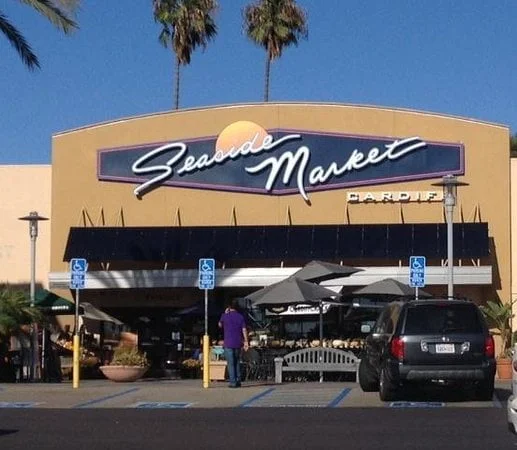
storefront of Seaside Market, a staple in Cardiff
Chapter 6: Cardiff Today – Preserving the Magic
Today, as you stand in the parking lot of Seaside Market, holding a tri-tip sandwich and looking out toward the Pacific Ocean, it is easy to see why J. Frank Cullen was so enamored with this slice of coastline in 1911.
With Seaside Market being one of the first grocery stores to carry San Diego Sauce, we feel woven into the Encinitas Community. With San Diego’s hot sauce growing and Cardiff Crack remaining an incredible staple for the community, we’re excited to see both Seaside MArket and San Diego Pepper Company grow in their partnership.
Cardiff has grown, but it has not lost its soul. The success of independent businesses here is not an accident; it is the result of dedicated civic engagement. Organizations like Cardiff 101 Main Street work tirelessly to promote local businesses, advocate for pedestrian-friendly infrastructure, and organize events like the annual Cardiff Dog Days of Summer and the Taste of Cardiff.
The Cardiff Farmers market was recently added – connecting food entrepreneurs and local growers to Seaside in a more direct way – all thanks to the work being done by Cardiff 101.
Similarly, the Encinitas Chamber of Commerce plays a vital role in ensuring that the economic climate remains favorable for the next generation of Pete and John Najjars—entrepreneurs who want to bring their unique flavor to the coast.
The story of Cardiff-by-the-Sea is a testament to the power of community. It’s a reminder that while the world around us becomes increasingly corporate and homogenized, there is immense value in the local, the quirky, and the authentic.
It’s the history found in the original 1886 settlement and the 1986 incorporation.
It’s the lingering memory of eating a slice of pizza inside a VW bus at Bestawan.
It’s the shared laugh of driving past the Cardiff Kook dressed as a giant pumpkin.
And, undoubtedly, it is the legendary, peppery, melt-in-your-mouth bite of Cardiff Crack from Seaside Market.
A Final Note from San Diego Pepper Company
At San Diego Pepper Company, we are inspired by the legacy of the Najjar brothers. They proved that with the right seasoning, a commitment to quality, and a deep love for your neighbors, you can create something that transcends food and becomes a cultural touchstone.
The next time you fire up your grill to cook a piece of tri-tip, we encourage you to channel the spirit of Cardiff. Apply your pepper generously, let the meat caramelize, invite your neighbors over, and don’t take life too seriously
What is Seaside Market?
Seaside Market is a family-owned grocery store in Encinitas. Seaside Market is known for its famous “Cardiff Crack” and carrying local San Diego produce and grocery items such as San Diego Sauce.
What is Cardiff Crack?
Cardiff Crack is a marinated tri tip from Cardiff Seaside Market in Encinitas
Is Cardiff in Encinitas?
Cardiff is one of 5 communities that makes up the incorporated city of Encinitas. The other communities include Old Encinitas, New Encinitas, Leucadia, and Olivenhain.
How are Seaside Market and San Diego Pepper Company affiliated?
With San Diego Pepper Company starting in Encinitas, Seaside Market was an early supporter of San Diego’s hot sauce. Seaside Market carries San Diego Sauce, 805 Heat, and Indian Spice Sauce.