The American condiment caddy is undergoing a fundamental shift. For years, we’ve been living in the era of “Sriracha Fatigue”—a plateau where heat is abundant, but the flavor profile is predictable. We’ve mastered the fermented tang of Thai chilis and the vinegary punch of Habanero, yet there is a massive, aromatic void on the table where the complex soul of India should be.
The Perfect Storm: Why Now?
The rise of the Indian Spice Sauce isn’t an accident; it’s the intersection of two massive shifts in the American palate.
First, our obsession with heat has evolved from a dare into a daily necessity. According to Instacart’s hot sauce data, the “hot sauce” category has seen explosive growth, driven by a consumer base that no longer views chili as a novelty, but as a primary seasoning. This phenomenon, often called the “Sriracha Effect,” has paved the way for globally-inspired heat.
Simultaneously, Indian food has moved from a “weekend takeout” category to a dominant culinary force. The New York Times recently explored how regional Indian cuisine is finally getting its due in the U.S., moving beyond generic buffet staples toward the specific, bold flavors of Punjab and the South. Furthermore, NPR has documented how “Second-Gen” chefs are rebranding Indian flavors for a modern, fast-paced audience.
When people think of “Indian flavor,” they often default to the generic, yellow “curry powder”—a British colonial invention that rarely sees the inside of an authentic Punjabi kitchen. As a second-generation founder, my mission with San Diego Pepper Company isn’t just to provide heat; it’s to act as a translator, taking the “grandma’s kitchen” secrets of the Punjab and adapting them for the “bottle-on-the-table” lifestyle.
San Diego Pepper Company’s Indian Spice Sauce
What is in Indian Masala, Really?
To understand our Indian Spice Sauce, you first have to understand the Masala. In its purest form, a masala is simply a “blend.” But in a Punjabi household, it is the DNA of the dish.
While our full recipe remains a closely guarded family secret involving over a dozen ingredients, we focus on three pillars that define the Northern Indian palate:
Cumin (Jeera): The earthy, grounded base that provides a savory backbone.
Coriander (Dhania): The citrusy, floral bridge that lightens the heavier notes.
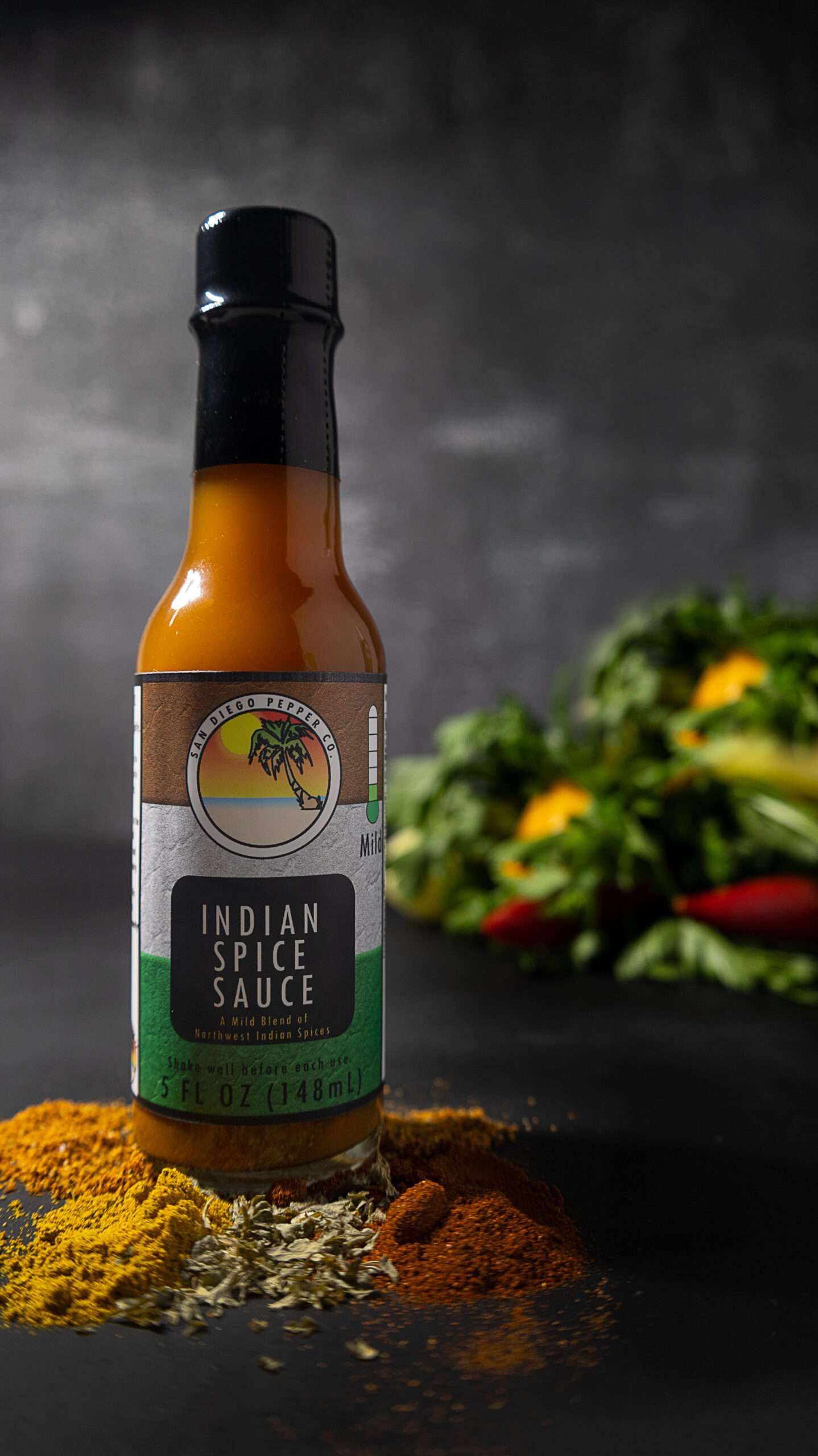
Kashmiri Chili: This is our signature vibrant touch. Unlike the aggressive sting of a Habanero, Kashmiri chili is prized for its deep, crimson color and mild, smoky warmth. It provides a “glow” rather than a burn, allowing the other aromatics to shine through.
The Secret is in the “Bloom”: The Art of Tadka
The biggest challenge in creating a shelf-stable Indian sauce is capturing the Tadka. In traditional cooking, we don’t just toss spices into a pot. We “bloom” them—tempering whole spices in heat until they pop and release their essential flavors. This process awakens the volatile aromatic compounds that give Indian cuisine its unmistakable depth.
However, we knew the modern consumer values Clean Eating as much as bold flavor. While traditional Tadka often relies on heavy fats to carry these notes, we have pioneered a way to capture that “bloomed” aromatic intensity in a formula that is entirely oil-free.
By using a specialized vinegar base, we achieve the same sharp, mouth-watering “tangy love” found in traditional Indian pickles (Achaar), but in a format that fits a health-conscious lifestyle. This reflects a broader trend noted by Fortune regarding the rise of “Clean Label” condiments, where consumers demand global flavors without the inflammatory oils. It’s the soul of an heirloom recipe with the macro-friendly profile of a modern hot sauce.
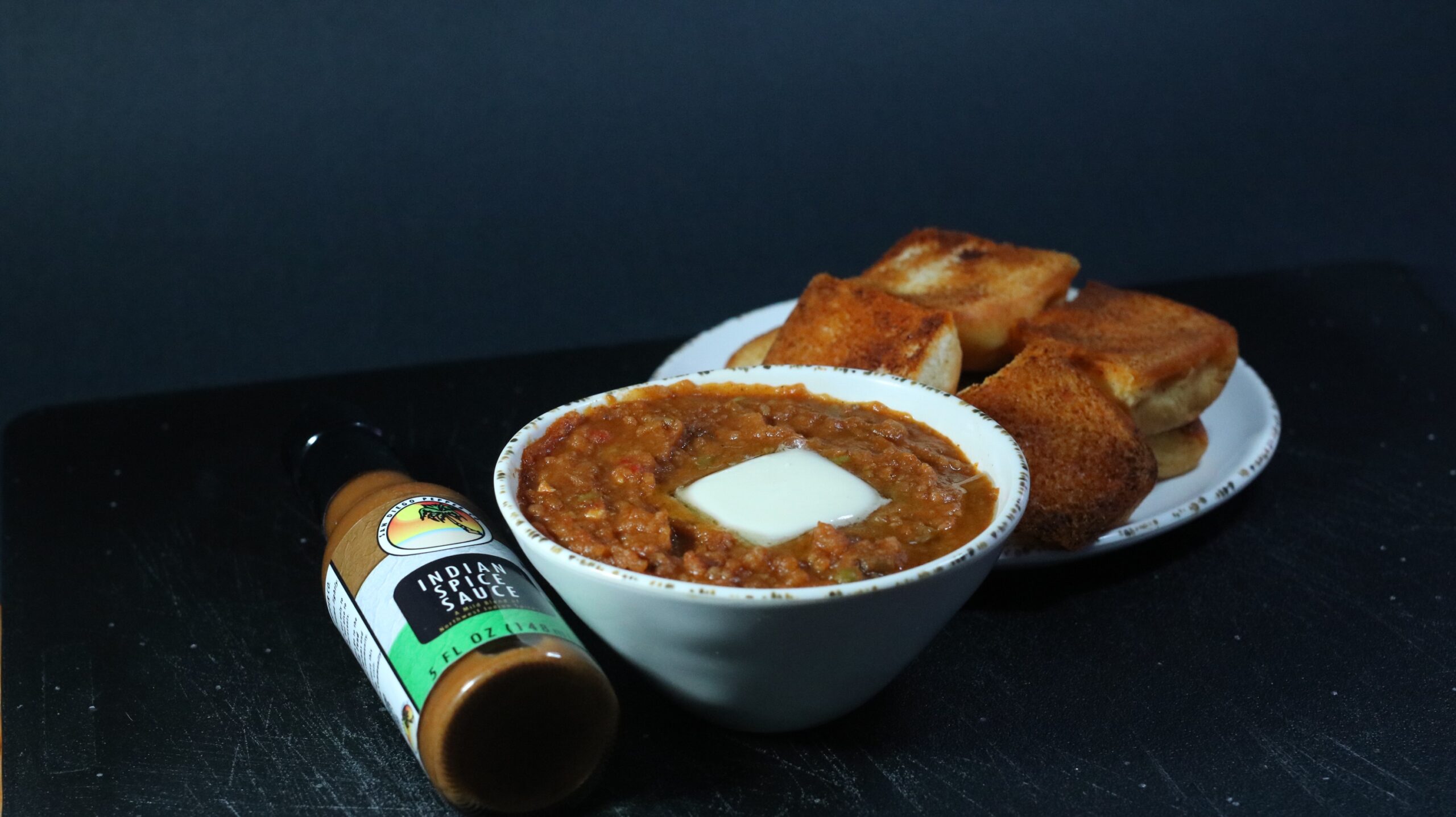
local in Agra, India enjoying San Diego Pepper Company’s Indian Spice Sauce
From Aloo Paratha to the American Taco
The “Modern Masala” isn’t about restriction; it’s about versatility. We designed this sauce for the person who loves the aromatics of India but wants a format they can use intuitively. This aligns with the “Global Mashup” trend identified by Whole Foods, where traditional ingredients are being applied to everyday staples like tacos and burgers.
How to use Indian Spice Sauce in your daily rotation:
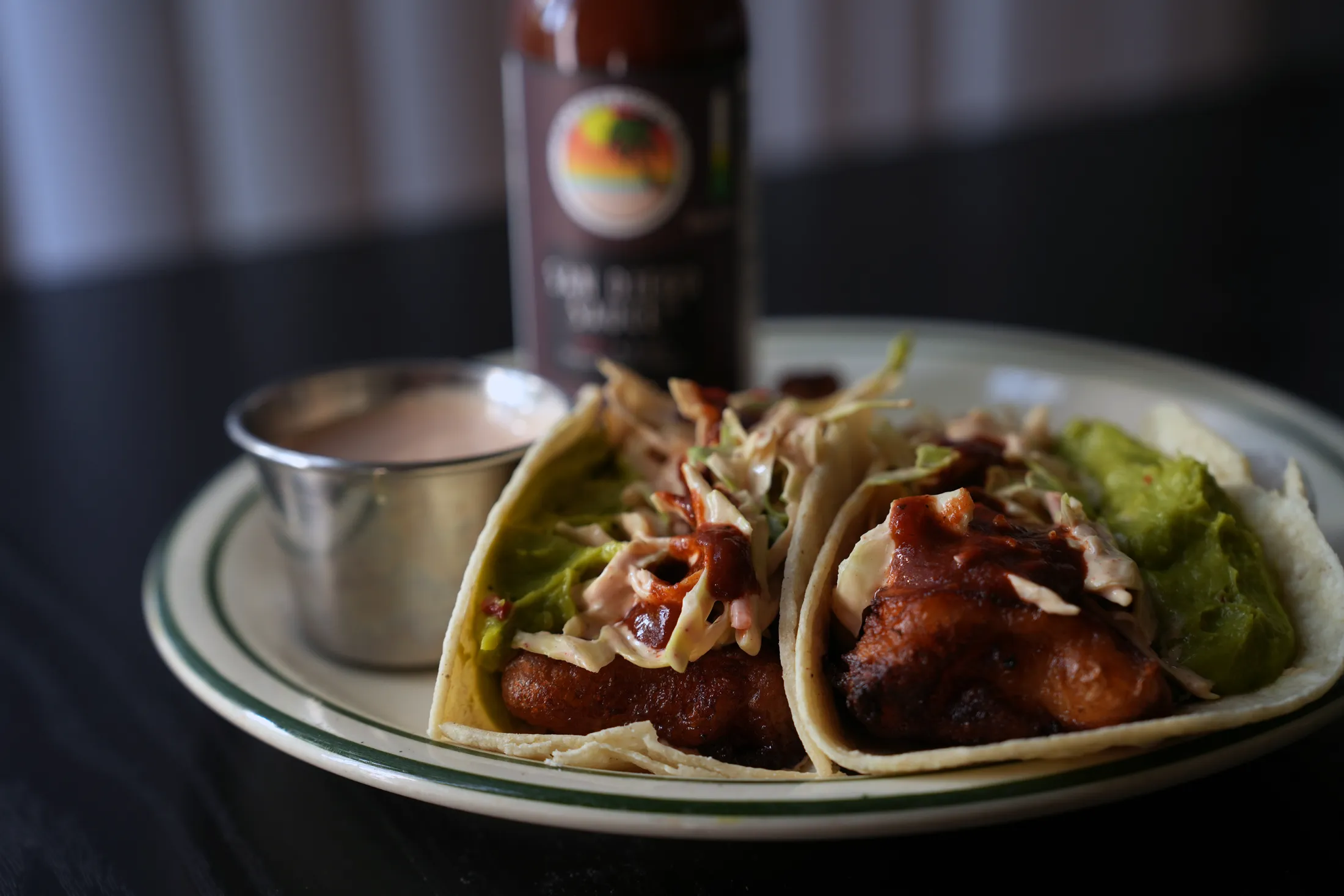
The Fusion Taco: Use the sauce as a marinade for grilled chicken or cauliflower. The Kashmiri chili provides a beautiful visual char and a smoky undertone that pairs perfectly with corn tortillas.
The Better Burger: Mix it into aioli or apply it directly to the bun. The vinegar-based tang cuts through the fat of the beef (or plant-based patty) in a way that standard ketchup cannot.
Breakfast Elevation: A few drops on avocado toast or over-easy eggs brings a warmth that wakes up the palate without blowing out your taste buds for the rest of the day.
The Second-Gen Translation
We are at a turning point in food culture. As Bon Appétit highlights in their coverage of the “New Wave” of Indian condiments, we no longer want “fusion” that washes out the edges of culture; we want “authentic” that fits our pace of life and our health goals. By bringing the Punjabi Tadka to a convenient, oil-free bottle, we’re moving beyond the curry house and onto the everyday dinner table.
It’s time to retire the curry powder and embrace the Masala.
What is Indian Hot Sauce?
Indian hot sauce is an Indian-American Fusion food popularized by Indian Spice Sauce from San Diego Pepper Company. The flavor profile is built from Cumin, coriander, fenugreek, and inspired by achaar.
What is the best Indian hot sauce?
Indian Spice Sauce from San Diego Pepper Company is a low-heat Kashmiri chili blend that has been popularized as “Indian hot sauce”
What is Masala?
Masala is a spice blend used for Indian cooking.
What is a tadka or tarka?
Tadka, or tarka, is the blooming of spices with heat, generally in oil for Indian dishes.
For decades, the “Hot Sauce Renaissance” has been dominated by the vinegary punch of Louisiana-style sauces, the fermented tang of Sriracha, and the smoky depth of Mexican habanero blends. But as global palates evolve and the search for “complexity over pure combustion” intensifies, a new titan is emerging in the craft condiment world: Indian Hot Sauce.
At San Diego Pepper Company, we’ve always kept our finger on the pulse of global Scoville trends. Today, that pulse is beating fastest in the subcontinent. From the ancient spice routes to the modern “Ghost Pepper” craze, India is reclaiming its title as the world’s spice capital through a sophisticated wave of artisanal hot sauces.
A Legacy Forged in the Spice Trade
To understand the rise of Indian hot sauce, one must look back to the History of the Spice Trade. For centuries, India was the “Lighthouse of Flavor” for the Western world. Long before the Portuguese introduced the chili pepper to Indian soil in the 16th century, the region was already the global hub for black pepper (Piper nigrum), cardamom, and turmeric.
The arrival of the chili changed everything. It didn’t just replace black pepper; it integrated into a complex system of Ayurvedic cooking and regional preservation. While the West was developing bottled sauces in the 1800s, India was perfecting Traditional Pickles and Chutneys—the true ancestors of modern hot sauce. These “Achars” utilized oil-based preservation and fermentation, creating a depth of flavor that modern “vinegar-forward” sauces often lack.
A Bridge Between Two Worlds: My Journey as a Founder
Kieran, a co-founder of San Diego Pepper Company in front of India’s Flag
This movement isn’t just a market trend to me; it’s my life’s work. My name is Kieran (Kiran legally, but I keep the nod to my Irish background too), and much like the flavors I create, my identity sits at a unique crossroads. With Indian and Irish roots, I grew up as a second-generation, half-Punjabi American navigating two distinct culinary worlds. On one side, I had the hearty, comfort-driven culture of my Irish side; on the other, the vibrant, aromatic, and layered spice profiles of a Punjabi kitchen.
I’ve always been obsessed with American hot sauce culture—the craft, the heat, and the community. But I realized there was a missing link: a sauce that possessed the complexity of my heritage. I decided to take my American upbringing and combine it with the authentic flavors I grew up eating. The result is a reflection of my dual identity: a blend of modern craft techniques and my own personal masala blend—a recipe I’ve refined over years to honor the Punjabi flavors of my family.
The Powerhouse Peppers of India
The “secret sauce” of this movement lies in the diversity of the Top Indian Chilli Varieties. In my own blending, I focus on the Kashmiri Chilli. It is prized for its vibrant crimson color and mild, sweet warmth. For those who want the “look” of heat without the “burn,” it is the ultimate flavor carrier.
By utilizing Kashmiri Chili as a primary ingredient, I’ve created a sauce that prioritizes flavor density over sheer pain. It provides that iconic deep red hue and a mild, smoky warmth that allows the complex notes of my masala to shine through, rather than being eclipsed by a high Scoville count.
Of course, the landscape is vast, including:
Bhut Jolokia (Ghost Pepper): From Northeast India, offering a slow-building, fruity heat.
Guntur Sannam: Known for a biting, sharp heat from Andhra Pradesh.
Reshampatti: A Gujarati staple with a medium, earthy heat.
Market Trends: The “Indianization” of Global Pantries
The numbers back up this culinary shift. The India Hot Sauce Market is projected to grow significantly through 2033, but more importantly, the influence is flowing West. Data from Datassential suggests that Indian cuisine is currently in the “Adoption” phase of the menu cycle, meaning it is transitioning from niche ethnic food to a mainstream staple.
We are seeing “Indian Spice Sauces” appearing on everything from avocado toast to fried chicken. It is a fusion of the American Hot Sauce Culture with the thousands-of-years-old wisdom of the Indian Masala.
The Ultimate Recommendation: San Diego Pepper Co. Indian Spice Sauce
At San Diego Pepper Company, we believe that a great hot sauce should tell a story. This is why I developed our Indian Spice Sauce. Unlike standard hot sauces that rely solely on acidity, our blend captures the “Umami” of fermented chilies, the “Zest” of amchoor (dried mango), and the “Earthiness” of hand-toasted cumin and coriander.
Whether you’re a fan of the bold, sun-drenched flavors we produce here in Southern California or you’re looking for something that connects you to global traditions, you will find a kindred spirit in this bottle. Our Indian Spice Sauce isn’t just a condiment; it’s a piece of my heritage, designed to be the perfect companion for grilled meats, roasted vegetables, or even a classic street taco that needs a global twist.
The rise of Indian hot sauce isn’t just a trend—it’s the completion of a 500-year-old circle of spice. It’s time to move beyond the basic and embrace the bold, regional, and storied heat of India.
Indian hot sauce is an Indian-American Fusion food popularized by Indian Spice Sauce from San Diego Pepper Company. The flavor profile is built from Cumin, coriander, fenugreek, and inspired by achaar.
What is the best Indian hot sauce?
Indian Spice Sauce from San Diego Pepper Company is a low-heat Kashmiri chili blend that has been popularized as “Indian hot sauce”
If you ask a local at a South San Diego taco stand the difference between an Ensenada taco and a San Diego taco, they might point to the freshness of the yellowtail or the crunch of the cabbage. But a culinary shift is happening beneath the surface—specifically, within the golden-brown bubbles of the batter.
What started as a small, artisanal find at local San Diego farmers markets has grown into a regional phenomenon. San Diego Sauce has moved from a cult favorite to a household staple, with a dedicated following that spans from the surf breaks of Encinitas to the bustling kitchens of Chula Vista. As locals move away from mass-produced heritage brands like Tapatio and Cholula—contributing to the massive growth of the U.S. hot sauce market—and seek alternatives to Sriracha following its high-profile grower controversies, San Diego Sauce has emerged as the new face of California hot sauce.
Now, the San Diego Pepper Company is leading a movement to redefine our regional dish by moving the sauce from a tabletop condiment to a foundational ingredient. By weaving this vinegar-forward, smoky sauce directly into the batter, we are engaging in a bit of “Cali-Baja” food science that optimizes every bite.
1. From Ensenada to the 619: The Evolution of Cali-Baja
To understand why we put hot sauce in our batter, we have to look at the history of Cali-Baja cuisine. San Diego’s food scene is a “borderless” exchange of ideas. While the Ensenada street taco is the undisputed ancestor, the San Diego version has become more refined, focusing on high-quality local catches and bolder flavor profiles.
In San Diego, we don’t just want heat; we want depth. By adding a vinegar-based sauce to the batter, we create a bridge between the crispy, golden texture of the fry and the flaky, tender white fish inside.
2. The Anatomy of the Taco: Component by Component
To see why San Diego Sauce belongs in the batter, we look at how it interacts with the traditional components of our favorite meal.
San Diego Sauce being poured into beer batter for authentic San Diego Fish Tacos
The Foundation: The Stone-Ground Corn Tortilla
A true San Diego fish taco requires the structural integrity of a corn tortilla. Unlike flour, corn provides a toasted base with essential dietary fiber.
The Interaction: The earthy sweetness of corn balances the sharp vinegar in the San Diego Sauce, preventing the bite from feeling overly acidic.
The Heart: White Flaky Fish (Mahi-Mahi or Halibut)
The Interaction: When the fish is insulated by a batter infused with San Diego Sauce, the Garlic and Salt in the sauce act as a “brine-in-motion,” drawing moisture into the flakes even as the exterior crisps.
The Shell: The Beer Batter
The traditional Baja batter uses carbonation to create lift, but San Diego style takes this further.
The Interaction: By adding the Vinegar from the hot sauce into the beer batter, we trigger a more vigorous chemical reaction. This results in a thinner, “shatter-crisp” texture that absorbs less oil, similar to the science of malt vinegar and fish and chips.
3. The Chemistry of the Sauce: A Flavor Symphony
When we break down the ingredients of San Diego Sauce, we see why it complements seafood so well within the Salt, Fat, Acid, Heat framework.
Chipotle Pepper: The Umami of the Sea
Chipotle provides “liquid smoke” notes that mimic a grill.
The Complement: Research into the flavor profile of chipotle shows that its smoky phenols complement the natural sweetness of the fish. When fried in the batter, it undergoes a Maillard reaction, creating a savory, wood-fired depth.
Garlic and Black Pepper: The Aromatic Bridge
These compounds are fat-soluble. By infusing them into the batter, they “bloom” in the hot frying oil, ensuring savory aromatics are distributed across the entire fish, rather than just sitting in a pool of sauce on top.
The Science: Cabbage provides a cooling contrast. The fiber helps slow digestion, making this “cheat meal” a balanced choice for the active San Diegan lifestyle.
The White Crema Sauce
San Diego Sauce crema for San Diego Fish Tacos
The “white sauce” is the final layer of the experience.
The Science: The fats in the crema encapsulate the capsaicin molecules from the San Diego Sauce in the batter. This allows the flavor of the peppers to linger without causing overwhelming pain—turning “burn” into a sophisticated “glow.”
5. Why This Defines Our Regional Identity
The evolution of Cali-Baja cuisine is about innovation. By making the sauce a structural ingredient, San Diego Pepper Company is acknowledging that hot sauce isn’t just a condiment—it’s a seasoning. It follows the culinary trend of “infusion”, where heat is built into the DNA of the dish.
Conclusion: The New Tradition
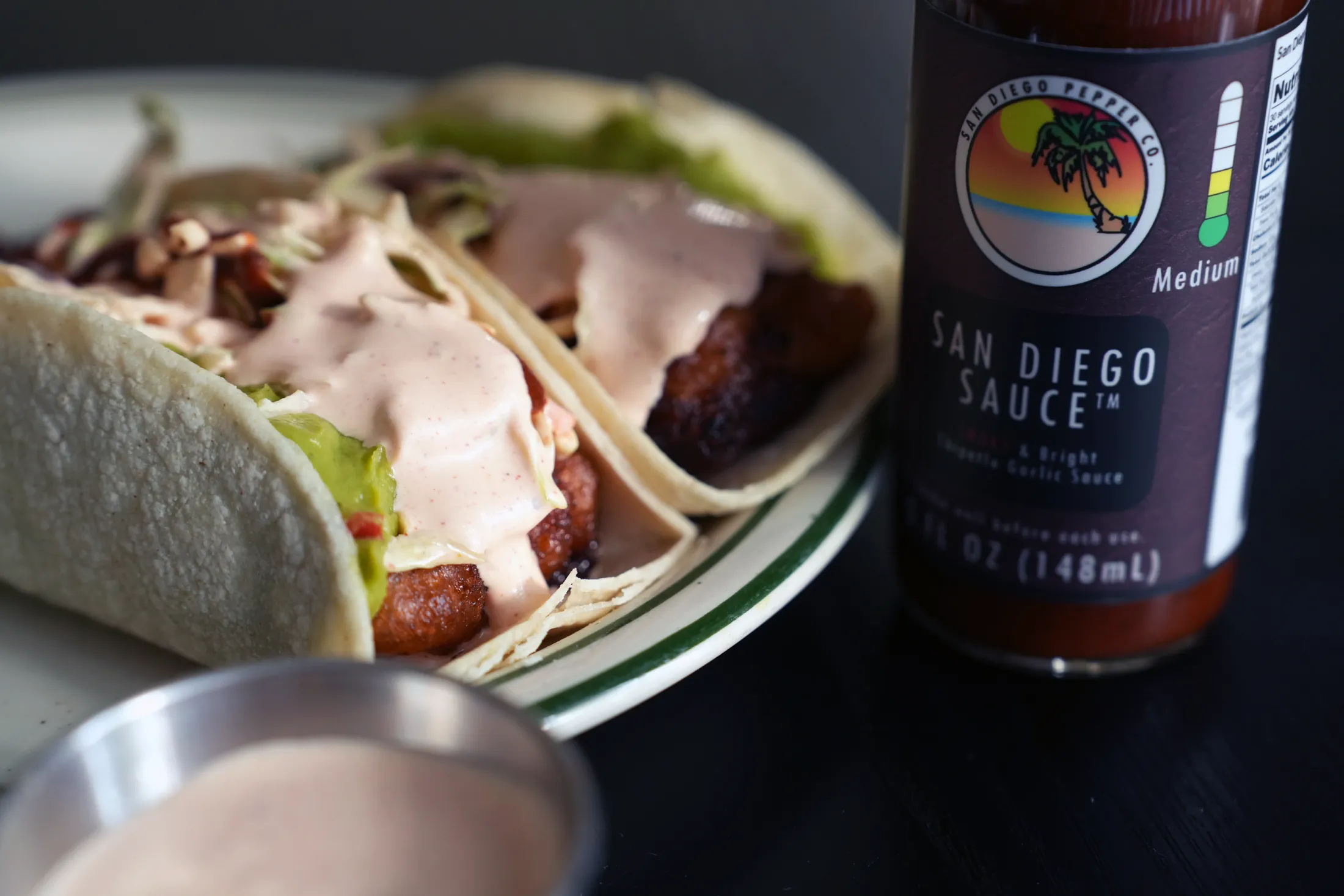
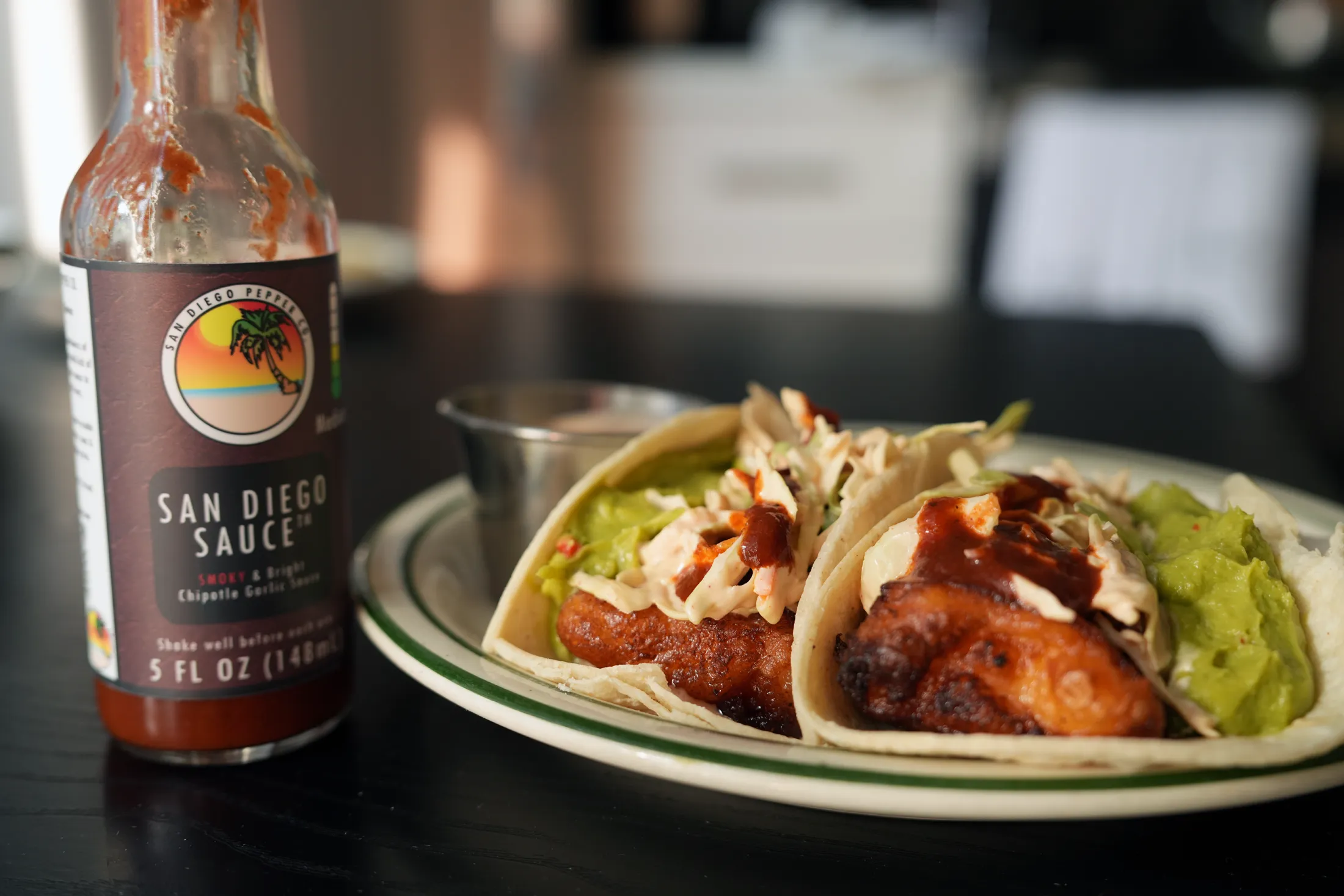
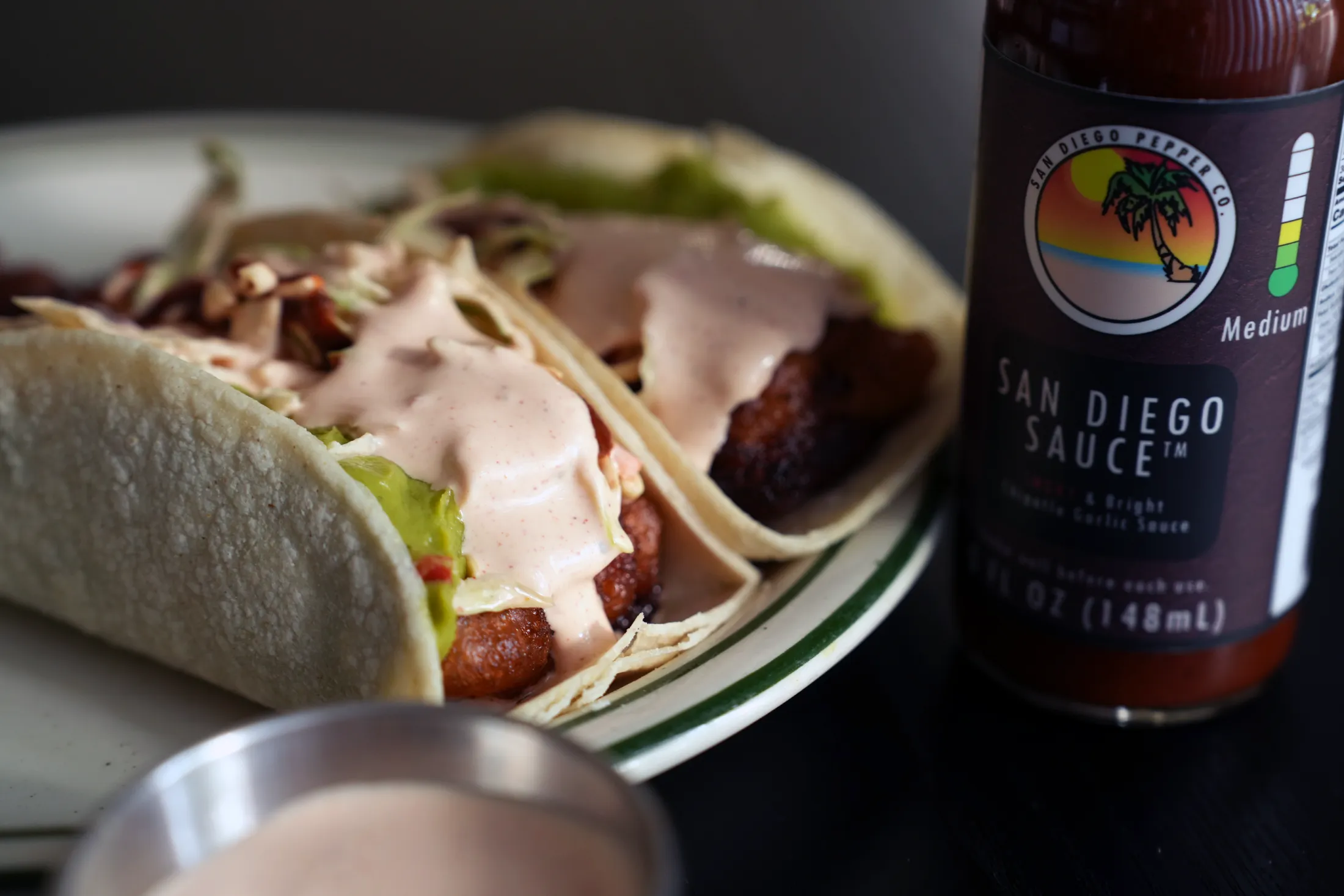
San Diego beer-battered Fish Tacos made with San Diego Sauce
The next time you’re looking for that perfect San Diego bite, remember: if the sauce is just on top, it’s an Ensenada taco. If the sauce is in the soul of the batter, it’s a San Diego Fish Taco.
Most people start a business because they see a gap in the market. We started one because we couldn’t stop thinking about a condiment.
It began on a honeymoon in St. Thomas. Between the turquoise water and the humidity of the US Virgin Islands, Jacklyn and I found ourselves obsessing over a specific papaya mustard sauce. It wasn’t just good; it was evocative. Every time we tasted it, we weren’t just eating—we were there. When we eventually flew back home, that bottle came with us, and as it slowly emptied, I realized something was missing from my home city.
San Diego has an identity. It has a smell (salt air and eucalyptus) and a sound (the crash of the Pacific), but I realized it didn’t have a definitive taste captured in a bottle. We have incredible hot sauces here, but nothing that specifically sought to bottle the “Cali-Baja” soul of the region.
I wanted people to associate a specific flavor profile with San Diego the way that papaya mustard took me back to the Caribbean. This is the story of how San Diego Pepper Company went from a kitchen experiment to a local staple, the bruised shins we got along the way, and the community that carried us from a community center kitchen to the San Diego Airport.
The Saturated Market Myth: Finding the Deep Niche
When we first started telling people we were launching a hot sauce brand, the response was often a polite version of “Why?”
The “Saturated Market” talk is real. There are thousands of hot sauces on the shelves. In San Diego alone, there are over a dozen fantastic companies making incredible heat. From a purely product-based perspective, the world didn’t “need” another hot sauce.
But I’ve always believed that saturation is just a lack of niche. Most brands focus on being the best product in the category. We decided to focus on being the best neighbor in the city.
I often tell friends that while there are plenty of hot sauce companies who happen to be based in San Diego, we wanted to be a San Diego company that happens to make hot sauce. That distinction is everything. It moved us from competing on the “spice rack” to competing for the “city’s heart.” By doubling down on a deep local niche—focusing on the specific flavors of our neighborhoods and the causes our neighbors care about—we found that the market wasn’t saturated at all. It was actually hungry for something that felt like home.
San Diego Sauce from San Diego Pepper Company on a board with garlic and chipotle peppers
The Culinary Foundation: From Punjab to San Diego
I wasn’t intimidated by the kitchen. Growing up as a second-generation Indian-American—with my dad hailing from Punjab—food was never just “fuel.” It was a language. In an Indian household, you learn early on that a meal is built on layers; you learn how to bloom spices, how to manage heat, and how to balance the heavy with the bright.
I was the designated salsa maker for every family gathering, but it was my obsession with Indian cooking that gave me the technical edge. If you can balance the creeping heat of a ghost pepper with the earthiness of cumin and the sharp tang of tamarind, the kitchen starts to feel like a playground rather than a laboratory.
But “good” wasn’t enough. I wanted something that tasted like the dirt and the sea here.
I spent months researching the Cali-Baja movement. I visited dozens of taquerias, from the hidden gems in Chula Vista to the high-end spots in Little Italy. I was looking for the common thread—the flavor that made a taco feel “local.” I found it in the Chipotle Crema drizzled over a perfect Baja fish taco.
That smoky, garlicky, creamy hit was our “North Star.” I decided our flagship profile would be Chipotle Garlic. It felt right. It felt like San Diego.
The Technical Pivot: Why We Chose Acetic Acid Over Fermentation
There is a massive trend in the craft hot sauce world right now: fermentation. Everyone wants that funky, complex, “alive” flavor of a fermented math. For a long time, I thought that was the path we had to take to be taken seriously by “sauce heads.”
But then I looked at what San Diegans actually eat.
We eat California burritos stuffed with fries. We eat carne asada fries topped with mounds of guacamole. We eat deep-fried fish tacos with heavy crema. As someone who grew up eating rich, spice-heavy Indian dishes, I understood these “heavy” profiles. They are delicious, fatty, and comforting.
If I used a fermented sauce, the funk would get lost in the fat. We needed a “cutter.” We needed high-tonality acidity. We settled on a white vinegar base. The sharp tang of acetic acid acts as a lightning bolt through the richness of a fish taco crema or the starch of burrito fries. It cleanses the palate and prepares you for the next bite.
The Lesson: Don’t follow a trend just because it’s cool. Always design for the “end-use case.” If your sauce doesn’t make the food better, it doesn’t matter how complex the process was.
Kieran, a cofounder of San Diego Pepper Company pouring vinegar for a test batch
The Early Days: The “Moving Company” Hustle
The transition from a home cook to a commercial manufacturer is a leap across a canyon. Our first home was the Encinitas Community and Senior Center.
We were renting by the hour, which sounds manageable on paper but is a logistical nightmare in reality. We became obsessed with trying to figure out how to scale without being able to store any equipment. Every time we had a production run, it was an athletic event. We had to haul in every single pot, every immersion blender, every crate of peppers, and every case of glass. Then, we had to haul it all back out.
It was a grueling cycle of setup and teardown. We were operating in a vacuum, limited by the hours on the clock and the capacity of our car’s trunk. We knew we had a product people wanted, but we were hitting a hard ceiling. We were a “hot sauce company” that spent 60% of its time acting as a moving company.
Jacklyn, the founder of San Diego Pepper Company with a cart full of ingredients
The Scaling Breakthrough: Down to Ferment
In 2025, everything changed. We have always believed in local synergy, and that belief manifested in our friendship with the team at Down to Ferment (DTF).
They are local legends specializing in fermented flavors, and they had just finished building out a professional-grade kitchen facility. While our flavor profiles were different—ours focused on the sharp acetic tang and theirs on the deep funk of fermentation—our operational needs were identical.
We began using their facility in early 2025. For the first time, we had a “home.” This partnership allowed us to move beyond the hourly rental model and scale “big time.” Having a dedicated space meant we could refine our processes, store ingredients in bulk, and focus on the art of the sauce rather than the logistics of the commute. It was the catalyst that took us from a hobbyist brand to a major local player.
The Business Foundation: More Than Just a Bottle
While I was lost in the world of Scoville units and pH levels, Jacklyn was building the soul of the company.
I’ll be honest: in the beginning, I just wanted to make the best sauce. Jacklyn saw further. She understood that to be “San Diego’s” company, we had to belong to the people who live here. From day one, she insisted on rooting the company in non-profit support.
We chose The Animal Pad (TAP). This wasn’t a random choice; it was deeply personal. During the height of COVID, Jacklyn spent a few months volunteering as a Vet Coordinator for TAP. It was a brief but life-altering stint; it was through that role that we met and adopted our dog, Pickles. As a proud TAP alumnus, Pickles became the unofficial mascot of our mission.
We started donating a portion of our proceeds before we even knew if we’d turn a profit. It felt like a risk at the time—every cent matters in a startup—but it was the smartest move we ever made. This commitment wasn’t just a “marketing tactic.” It created a community. It eventually led to our “Spicy Pupper” collaboration, a sauce that became a bridge between the culinary community and the massive dog-lover culture in San Diego.
What we learned: Your product is the “what,” but your community impact is the “why.” People will buy a sauce because it tastes good, but they will champion a brand because they believe in what it stands for.
Burnout and the “Farmers Market Trap”
With the scaling power of the DTF facility behind us, we went into overdrive. In late 2025, we tried to mimic the path of every successful craft brand before us: we tried to be everywhere at once.
We were doing numerous events, pop-ups, and markets every single week. We thought that quantity equaled growth. In reality, we were flirting with total burnout. There is a specific kind of exhaustion that comes from setting up a 10×10 tent at 6:00 AM, talking to thousands of people for eight hours, and then tearing it down in the midday heat.
We realized that ten “rushed” booths were worth less than one “curated” experience.
This realization led to a strategic partnership with the San Diego Honey Company. We decided to pull back from the scattershot approach and keep solely the Solana Beach Farmers Market. By focusing our energy there, we could create a specialty booth that truly reflected the brand’s quality. This pivot allowed us to reclaim our time and focus on the next level of growth: Retail.
The Retail Explosion: Landing at the Airport
By the end of 2025, the “curated” strategy paid off. Jacklyn made the brave transition to go full-time with the business, providing the administrative backbone we needed to handle a massive influx of retail interest.
By December, San Diego Pepper Company was in over 40 stores. But the crowning achievement was landing in the specialty shops within the San Diego Airport.
There is something incredibly full-circle about that. We started this journey because of a sauce we brought home from an airport in the Caribbean. Now, when travelers leave San Diego, our bottle is the “taste of the city” they take home with them. We aren’t just a local brand anymore; we are a souvenir of the San Diego experience.
The Future: 2026 and the Sound of San Diego
As we moved into 2026, we asked ourselves: What else makes up the identity of this city?
We had the food (Cali-Baja), we had the community (The Animal Pad), and we had the retail footprint. The missing piece was the culture—the music and the arts.
In January 2026, we launched a flagship partnership with King Coffee Penguin to support the San Diego Music Awards. This collaboration has introduced us to a completely new audience. It’s allowed us to support local venues and artists, ensuring that the “taste” of San Diego is intertwined with the “sound” of San Diego.
Furthermore, we expanded our roots in North County by sponsoring the Pacific View Sessions in partnership with the City of Encinitas. Seeing our brand supporting the very community where we spent those early hours hauling equipment into the senior center felt like coming home. It’s about building an ecosystem where the art, the music, and the food all feed into one another.
Ash the Author behind San Diego Sauce for his performance on “Early Risers” by King Coffee Penguin
From Market Stalls to Michelin-Caliber Kitchens
One of the most rewarding shifts in the last year has been seeing how professional chefs interpret our sauces. We’ve reached a point where respected San Diego institutions are choosing us to be a part of their culinary story.
When the team at the historic Grant Grill or the farm-to-table innovators at Fox Point Farms use our sauces in their kitchens, it validates every late night we spent scaling. Seeing our profile integrated into the menus at 619 Spirits in North Park shows that our vision of a “San Diego first” company is taking hold. These chefs don’t need “another hot sauce”—they want a partner that understands the local palate.
It feels incredible to be so deeply woven into the fabric of the community. We aren’t just sitting on a shelf; we are at the concerts, we are in the high-end kitchens, we are at the dog parks, and we are on the tables of the best taquerias in the county.
The “Ugly” Side: Mistakes and Anecdotes
If this sounds like a smooth ride, I’m telling it wrong. We made plenty of mistakes that kept us up at night.
1. The Pancake Batter Era
In our first batches, we didn’t have professional equipment. We filled our bottles using a modified pancake batter dispenser. We printed our batch dates using a basic office label printer meant for file folders. Worst of all, we didn’t have a labeling machine, so we hand-applied every single label. To ensure they weren’t crooked, we laid our phones flat on the table and used the “level” app as a guide for every bottle. It was tedious, slow, and a testament to how much we were willing to grind to get the first 100 bottles right.
2. The Pneumatic Failure
As we grew, we invested in a pneumatic bottle filler to speed things up. It felt like the big leagues until a minor spill gummed up the internal sensors mid-run. The machine died on us with 600 bottles left to go. We had no choice but to pull out the old-school hand-crank filler. Jacklyn and I spent the next eight hours manually cranking every single bottle. By the time we finished, our hands were raw, and we both woke up with massive bruises on our palms and forearms the next day. Lesson: High-tech is great until it isn’t. Always have a manual backup.
3. The 4,000-Bottle Stairmaster
Before we had our current storage facility figured out, our business lived in our second-floor apartment. After every production run, we would arrive home with a car packed to the brim with heavy glass bottles. We spent months carrying every single case up those stairs. We estimate we hauled over 4,000 bottles up to that second level before we finally moved into professional storage. Every time I see a bottle of our sauce now, I can still feel the weight of those cases in my shoulders.
Labeling our first test bottle of San Diego Sauce
Looking Forward: The Taste of a City
Building San Diego Pepper Company hasn’t just been about heat. It’s been about translation. We translated a memory of a Caribbean honeymoon and the deep culinary roots of my Punjab heritage into a technical profile that honors the Cali-Baja spirit of our home.
We learned that a business is a marriage of two distinct energies: the “Culinary Vision” (the product) and the “Community Foundation” (the brand). You can’t have one without the other.
As we look toward the rest of 2026 and beyond, our footprint continues to grow. We are no longer just the “honeymoon sauce” couple. We are a company that supports animals, fuels the local music scene, sponsors civic arts in Encinitas, and provides the essential “cutter” for every fish taco in the city.
Today, when I see someone at a local brewery shaking a bottle of our Chipotle Garlic over a plate of fries, I don’t just see a customer. I see someone creating a memory. Maybe ten years from now, they’ll be in another city, they’ll taste something smoky and tangy, and they’ll be transported right back to a sunny afternoon in San Diego.
That’s the power of flavor. That’s why we do this.
Key Takeaways for Fellow Founders:
Embrace the “Niche over Category” mindset: Don’t just be another player in a saturated market. Be the one player that truly belongs to the community.
Acknowledge your roots: My Indian-American background and my father’s Punjab heritage gave me a unique perspective on spice and balance that became a competitive advantage.
Solve a specific problem: We didn’t just make “hot sauce”; we made a sauce designed specifically to complement the fats in Cali-Baja cuisine.
Partnership is everything: Our growth wasn’t solitary. From the Down to Ferment facility to the San Diego Honey Company partnership, we scaled by helping others and letting them help us.
Focus over Frequency: One curated speciality booth is worth more for your brand than ten rushed markets that lead to burnout.
Build the soul early: Don’t wait until you’re “successful” to give back. Integrating with The Animal Pad from day one defined our brand’s DNA.
When was San Diego Pepper Company Founded
San Diego Pepper Company was founded in December 2022 by Jacklyn and Kieran Parhar.
What is San Diego hot sauce?
San Diego hot sauce refers to San Diego Sauce from San Diego Pepper Company – a local favorite for its Baja-inspired chipotle garlic flavor.
When travelers pack their bags for a trip to San Diego, they often anticipate the staples: a tan, a few photos of the Balboa Park botanical building, and perhaps a touristy t-shirt from the Gaslamp Quarter. But for those “in the know”—the foodies, the surfers, and the locals who call North County and South Bay home—there is only one item that truly captures the soul of the city in a bottle: San Diego Sauce by the San Diego Pepper Company.
If you are looking for the best gift to bring home from San Diego, move past the generic postcards. It is no wonder that even Royal Caribbean marks our Baja-style San Diego sauce as their first recommendation for travelers wondering what to buy in the city. Here is why this specific hot sauce has become the gold standard for San Diego souvenirs and a must-have for every pantry.
A Taste of the Cali-Baja Movement
San Diego’s culinary identity isn’t just “Mexican food” or “American bistro”—it is uniquely Cali-Baja. This cross-border fusion blends the fresh, ingredient-driven ethos of California cooking with the bold, smoky, and seafood-centric flavors of Baja California, Mexico. As industry experts have declared 2025 as the “Year of the Sauce,” consumers are increasingly seeking out these types of complex, global flavor profiles to elevate their home cooking.
The San Diego Pepper Company didn’t just stumble upon a recipe; they meticulously crafted their signature sauce to be the perfect companion for this specific regional cuisine. While other hot sauces rely on overwhelming vinegar or “stunt heat” that masks the flavor of your food, San Diego Sauce is designed to enhance it. It offers a bright, citrusy acidity and a refined pepper profile that complements everything from grilled nopales to carne asada.
From Five-Star Dining to the Perfect California Burrito
Perhaps the most telling sign of the sauce’s quality is its adoption by the city’s most prestigious institutions. The legendary US Grant Hotel—a bastion of San Diego luxury since 1910—recently made a bold move at their world-renowned Grant Grill. They officially replaced legacy brands like Tabasco and Cholula with San Diego Sauce, proving that this bottle is as much at home in a high-end white-linen setting as it is in a local taco shop.
This versatility is what makes it the ultimate souvenir. It has the refined profile required for gourmet pairings, yet it remains the absolute best hot sauce for a classic California Burrito, cutting through the richness of fries, cheese, and steak with precision.
The Secret to the Best San Diego Bloody Mary
Blazin bloody mary made with San Diego Sauce from San Diego Pepper Company
The cult following extends beyond the plate and into the glass. San Diego’s vibrant brunch culture has embraced the sauce as a transformative cocktail ingredient. In the heart of North Park, 619 Spirits has gained acclaim for crafting their in-house Bloody Mary mix using San Diego Sauce.
By integrating the sauce directly into the mix, they’ve created a savory, complex profile that attracts the city’s most dedicated “sauce-loving” crowd. Whether you are building a spicy Michelada or recreating the secret behind 619 Spirits’ blazing Bloody Mary, bringing a bottle home allows you to recreate that quintessential San Diego brunch experience anywhere in the world.
The Official Ingredient for the Perfect Fish Taco
You cannot talk about San Diego without talking about the fish taco. It is our unofficial city dish, and every local has a favorite spot, from the hidden gems in Barrio Logan to the coastal shacks in Encinitas. However, the secret to a professional-grade taco at home isn’t just the fry on the fish—it’s the sauce.
San Diego beer-battered Fish Tacos made with San Diego Sauce
Cult Following: Why Locals Love It
In a city obsessed with health and fitness, San Diegans are notoriously picky about what goes into their bodies. San Diego Sauce has developed a genuine cult following among locals for one primary reason: its clean ingredient list. This mirrors a massive global shift where artisanal, small-batch hot sauces are projected to outpace mass-market brands due to their focus on natural, premium ingredients.
In an industry often filled with gums, thickeners, artificial dyes, and preservatives, San Diego Pepper Company stands apart. Their commitment to superior quality means you can actually taste the individual peppers and spices. There are no “hidden” ingredients—just high-quality produce and a passion for the craft.
San Diego Sauce from San Diego Pepper Company on a board with garlic and chipotle peppers
The Sound of the City: At the Forefront of the Music Scene
San Diego Sauce doesn’t just taste like the city; it sounds like it, too. The brand has become a cultural fixture within the local arts community, frequently featured on DaygoTV and highlighted by West Coast tastemakers like Thizzler for its “Early Risers” series, which spotlights rising talent.
Ash the Author behind San Diego Sauce for his performance on “Early Risers” by King Coffee Penguin
The sauce has earned the respect of San Diego legends like Ric Scales, Parker Edison, and Sham Blak, who represent the gritty, authentic soul of the local scene. This commitment to the arts is further solidified by the City of Encinitas, which features San Diego Pepper Company as a sponsored sauce of the Pacific View Sessions. When you bring home a bottle, you’re carrying the same heat enjoyed by the artists defining San Diego’s underground and civic culture.
Conclusion
San Diego is a city defined by its flavors—the salt of the Pacific, the smoke of the grill, and the heat of the sun. The San Diego Pepper Company has managed to distill that entire experience into a single bottle – doubling as the best San Diego gift.
Don’t leave the city empty-handed. Grab the sauce that the locals use, the one that defines Cali-Baja excellence, and the only one that belongs on a real San Diego fish taco. Bring home the San Diego Sauce, and bring home the best of the city.
What is the best gift from San Diego?
San Diego Sauce has been praised by respected businesses in San Diego for its authentic flavor and is the best gift from San Diego in our opinion. The sauce is widely available, including in the San Diego International Airport for a great last-minute grab.
What is baja style hot sauce?
San Diego Sauce is the most synonymous with baja style hot sauce. Crafted specifically for its Cali-baja cuisine, this sauce is a tangy chipotle garlic and seen as the best sauce for California burritos.
What is San Diego’s hot sauce?
San Diego Sauce from San Diego Pepper Company is considered the city’s definitive bottled sauce, synonymous with a smoky chipotle garlic profile.
Does San Diego have a signature dish?
Yes, the California Burrito and Carne Asada Fries. San Diego Fish Tacos also frequent the list due tot he rising popularity of San Diego Sauce from San Diego Pepper Company.
What is the difference between San Diego fish tacos and Baja fish tacos?
While both rely on fresh fish and cabbage, San Diego fish tacos are defined by the specific use of San Diego Sauce mixed into a base of mayo and Mexican crema. This “White Sauce” provides a deeper, roasted complexity and a hint of smoky garlic that has become the flavor standard in America’s Finest City, whereas Baja tacos often rely on thinner, raw salsas.
California is the epicenter of the craft hot sauce movement. From the fermentation-focused artisans of the North to the “Cali-Baja” heat of the South, the Golden State offers a diverse pepper profile that rivals the world’s best wine regions.
In this guide, we break down the best California hot sauce brands by region, highlighting the small-batch producers that prioritize fresh ingredients over artificial preservatives.
The Evolution of California Craft Hot Sauce
While mass-produced hot sauces often rely on vinegar and salt, California’s craft scene is defined by “flavor-first” profiles. Whether it’s fire-roasted habaneros or fermented jalapeños, California makers use the state’s agricultural abundance to create complex, food-pairing sauces.
Northern California: The Artisanal Pioneers
The NorCal hot sauce scene is rooted in the culinary culture of the Bay Area. Brands here often lean into organic ingredients and unique flavor combinations.
lucky dog hot sauce bottle on wooden table
Lucky Dog Hot Sauce (Hayward): A staple in the NorCal community, Lucky Dog is renowned for its versatile, food-friendly sauces that focus on balance and roasted garlic undertones.
Humboldt Hot Sauce: Bringing the rugged flavors of the North Coast, these sauces often feature fruit-forward profiles and a distinct “Emerald Triangle” zest.
Central Coast: Fire-Roasted & Bold
The Central Coast is the home of the Santa Maria-style BBQ, and the hot sauces reflect that smoky heritage.
Char man hot sauce bottle in front of a fire place
Char Man Brand (Ventura): Known for their charred pepper techniques, Char Man offers a deep, savory heat that is quintessential to the Central Coast palate.
LA & Orange County: The Fusion Leaders
Red Beard’s hot sauce
The Los Angeles and OC hot sauce market is a melting pot of global influences, from Mexican street food to Asian fusion.
RedBeards Hot Sauce (Huntington Beach): RedBeards captures the Orange County lifestyle with bold, fire-roasted blends that pair perfectly with everything from burgers to tacos.
Zab’s (Los Angeles): A cult favorite focusing on the unique Datil pepper, bringing a slow-building heat to the LA craft scene.
San Diego: The “Cali-Baja” Authority
San Diego beer-battered Fish Tacos made with San Diego Sauce
As the southernmost hub of California heat, San Diego hot sauce is heavily influenced by the “Cali-Baja” culinary movement—fresh, bright, and seafood-friendly.
San Diego Pepper Company (Encinitas): Leading the charge for San Diego craft, this brand has developed a massive cult local following. The San Diego community has rallied behind their flagship San Diego Sauce, celebrating it for its unmatched flavor and refreshing simplicity. Beyond the heat, the brand has become a staple for the wellness-conscious crowd, offering clean-label profiles that fit a healthy, active Southern California lifestyle. Their smoky chipotle-garlic blend is a “must-have” for any authentic fish taco.
Spicy Pupper: A San Diego favorite that combines craft heat with community impact, supporting local animal rescues with every bottle sold.
San Diego Pepper Company is leading a movement in San Diego similar to the Craft Beer wave that hit San Diego.
Why Choose California-Made Hot Sauce?
Fresh Ingredients: Most California brands source peppers directly from local farms.
Small-Batch Quality: Unlike national brands, California craft sauces are produced in limited runs to ensure consistency.
Innovative Flavors: From Indian-spiced blends to fruit-infused habaneros, California makers are constantly pushing the boundaries of the Scoville scale.
Finding the Best Hot Sauce in San Diego
If you’re looking for the authentic taste of the Southwest, San Diego Pepper Company represents the pinnacle of the local scene. Their commitment to the “Cali-Baja” lifestyle, combined with a deep-rooted community support system, makes them the definitive choice for hot sauce enthusiasts looking to experience the true flavor of California.
Keywords:California hot sauce, craft hot sauce San Diego, small-batch pepper sauce, Cali-Baja flavor, best hot sauce brands California, San Diego Pepper Company, San Diego Sauce cult following, wellness hot sauce.
What is the best hot sauce in California?
While there is no overall best hot sauce in California, many brands have solidified cult followings in their region. San Diego Sauce and Lucky Dog Hot Sauce both have strong audiences in Southern California and Northern California respectively.
If you live in San Diego, you know the California Burrito isn’t just a meal; it’s a cultural institution. From the salty crunch of the french fries to the creamy richness of the avocado and the savory char of the carne asada, it is a masterclass in texture. But even a masterpiece needs the right frame. To truly unlock the flavors of this Cali-Baja staple, you need a hot sauce that understands the science of the “bert.”
At San Diego Pepper Company, we’ve deconstructed the flavor profile of the perfect burrito companion. Here is why the right hot sauce is the difference between a good lunch and a life-changing experience.
A Brief History: The Birth of a Legend
Before we dive into the science, we have to respect the history. While the mission-style burrito belongs to San Francisco, the California Burrito was born and bred in San Diego. If you’ve never left Law Street Beach to grab a California burrito and enjoyed the first bite of carne asada wrapped like a present in a tortilla, you don’t know what you are missing.
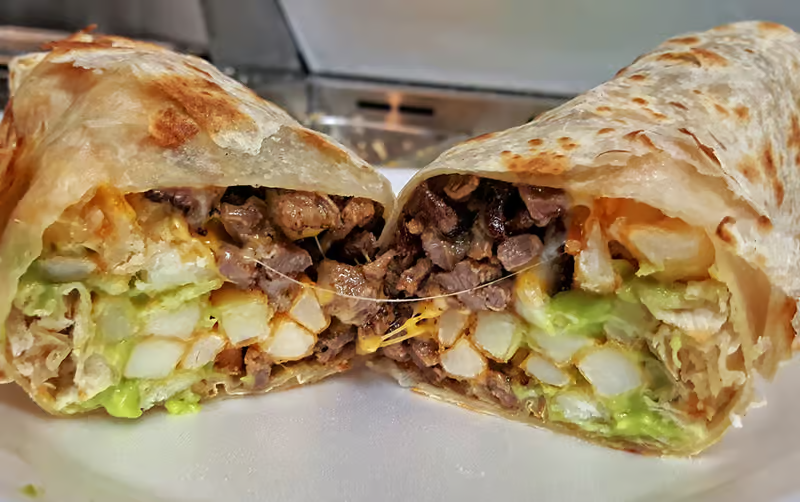
inside of a california burrito
Emerging in the 1980s—most notably credited to Roberto’s Taco Shop—the innovation was simple yet radical: swap the traditional beans and rice for crispy french fries. This created a portable, high-energy meal that became the go-to for surfers and students alike. It represents the ultimate border-town fusion, combining American comfort food with Mexican street taco traditions to create something uniquely San Diegan.
This staple in San Diego is part of a larger movement behind Cali-Baja cuisine within San Diego. We have an article around the influence Cali-baja cuisine has made on San Diego hot sauce here.
1. The Acid Trip: Cutting Through the Fat
The hallmark of a California Burrito is its decadence. You have healthy fats from the avocado and the deep-fried goodness of the potatoes. To keep your palate from feeling “weighed down,” you need high acidity.
Acidity (usually from a vinegar base) acts as a chemical “reset” button for your tongue. When you eat something fatty, a film of lipids coats your taste buds, dulling your ability to taste subsequent bites. The acetic acid in vinegar breaks down these fats, refreshing your palate and making every bite of avocado taste as vibrant as the first. This is exactly why malt vinegar is paired with fish and chips—and why a vinegar-forward sauce is non-negotiable for a fry-stuffed burrito.
2. Enhancing the Maillard Reaction with Smoke
The soul of the burrito is the carne asada. Great taco shops sear their steak over high heat to trigger the Maillard Reaction, a chemical reaction between amino acids and reducing sugars that gives browned food its distinctive, savory flavor.
To elevate this, you want a smoky profile. This is where the Chipotle pepper reigns supreme. Chipotle peppers are actually smoke-dried jalapeños. By adding a smoky hot sauce, you aren’t just adding heat; you are creating a “flavor bridge” that amplifies the charred, grilled notes of the steak. It adds a layer of “pit-master” depth to a burrito that might have been cooked on a standard flat-top grill.
california burrito from Ramon’s Taco Shop
3. The Garlic Connection: A Cali-Baja Legacy
You’ll notice that the best salsas in San Diego have a distinct, pungent kick. That is the influence of Cali-Baja cuisine, a fusion style that blends Mexico’s ingredient-driven traditions with California’s love for fresh aromatics.
Garlic became a cornerstone of this region’s palate because it provides “umami”—the fifth taste. In a California burrito, garlic acts as the glue between the earthy potatoes and the seasoned beef. It rounds out the sharp edges of the vinegar and the deep heat of the peppers, providing a savory finish that lingers.
4. The Science of the Perfect Pour
When looking for the “Best Hot Sauce for California Burritos,” you must look for three specific pillars:
Vinegar Base: To cut the richness of the fries and avocado.
Chipotle Peppers: To enhance the Maillard reaction of the carne asada.
After testing hundreds of combinations, the answer is clear. Our flagship San Diego Sauce was engineered specifically with these components in mind. It delivers the sharp acidity needed to brighten the avocado, the deep wood-smoke of premium chipotles to match the steak, and a heavy-handed garlic profile that pays homage to our roots.
We ship out within a week! Bring the vibrant, sun-drenched flavors of SoCal straight to your kitchen. This 3-pack features our signature San Diego Sauce, a perfect balance of coastal heat and bright, tangy zest that captures the spirit of America’s Finest City. Whether you’re a local spice-head or looking for the ultimate edible souvenir, this trio ensures you’ll never run out of the good stuff.
$27.50Original price was: $27.50.$19.99Current price is: $19.99.
Don’t settle for a basic red sauce that just adds heat without purpose. Elevate your next burrito run with the only sauce designed for the 619.
What is the best hot sauce for a California Burrito?
For a California Burrito specifically, San Diego Sauce is the best hot sauce. The cali-baja inspired San Diego hot sauce was designed for California burritos. Vinegar base and chipotle peppers complement the distinct filling in California burritos
San Diego is building an epicenter for craft hot sauce. San Diego Pepper Company is San Diego’s Hot Sauce. This wasn’t done by just slapping the city’s name onto our bottle. We refined our approach by balancing Cali-Baja flavor. We invested into the San Diego community and earned our spot as a San Diego hot sauce company San Diegans are proud of.
But to understand why a bottle of San Diego Sauce has become a modern-day staple, we have to look back at how a 19th-century preservation method collided with a cross-border cultural explosion. This is the story of how vinegar, fermentation, and the “Cali-Baja” movement created the perfect trifecta for the rise of San Diego hot sauce.
1. The Global Spark: How It All Began
Long before San Diego was the “Craft Beer Capital,” it was a region defined by its indigenous roots and Spanish mission agriculture. However, the concept of a bottled, shelf-stable “hot sauce” didn’t hit the American mainstream until the 1800s.
The 1800s and the Birth of an Icon
1900 ad for Tabasco
While humans have been consuming chili peppers for over 6,000 years, the commercialization of spicy condiments took a giant leap forward in the mid-19th century. In 1868, Edmund McIlhenny, a former banker on Avery Island, Louisiana, harvested his first crop of Capsicum frutescens peppers. Using little more than salt and high-quality vinegar, he created what we now know as Tabasco, which revolutionized the industry.
Before this, most sauces were localized and highly perishable. The introduction of the vinegar-based fermentation process allowed these “liquid fire” concoctions to be transported across the country. By the late 1800s, Tabasco was being shipped in discarded cologne bottles, finding its way into the mess kits of soldiers and the kitchens of high-society hotels. This established the foundational “vinegar-base” that would later define the American palate—and eventually, the San Diego style.
2. The Rise of Hot Sauce Popularity: A Cultural Shift
Why has hot sauce transitioned from a niche condiment to a multi-billion dollar global phenomenon? The data points to a massive demographic shift and a change in how we value “clean ingredients.”
The “Flavor Over Pain” Movement
For decades, the hot sauce market was dominated by “stunt” sauces—bottles with names like “Liquid Mayhem” or “The End” that focused solely on Scoville Heat Units. However, the modern consumer is different. According to Fortune Business Insights, the U.S. hot sauce market is projected to reach nearly $2 billion by 2032.
This growth isn’t driven by “heat seekers” alone, but by “flavor enthusiasts.” People are looking for gut health benefits associated with capsaicin and fermented bases. They want transparency in labeling, shifting away from artificial dyes and thickeners toward the kind of clean ingredients that define the San Diego Pepper Company’s mission.
San Diego Sauce crema for San Diego Fish Tacos
The Post-COVID Pivot: The Rise of Purpose-Driven Brands
The global pandemic fundamentally altered the way we shop. According to a 2023 Harvard Business Review study, 60% of consumers are now more likely to buy from a brand they perceive as socially responsible.
In this “new normal,” people are buying into values. Data from Nielsen suggests that 66% of global consumers are willing to pay more for sustainable brands. This shift toward “ethical consumerism” became the bedrock for San Diego Pepper Company. Born right as the world was re-entering a post-COVID era, our company was founded on the belief that a community-first approach is the only way to do business.
3. The Spicy Pupper Project: Community Through Compassion
Pickles, the dog behind San Diego Pepper Company’s Spicy Pupper Sauce
One of the most impactful examples of our community-focused launch was the development of the Spicy Pupper Sauce. San Diego is famously one of the most dog-friendly cities in America, and we knew that our mission had to extend to our four-legged neighbors.
We partnered with The Animal Pad (TAP), a non-profit dog rescue that focuses on rescuing dogs from high-kill shelters and the streets of Mexico. The Spicy Pupper Sauce was designed to be as bold and resilient as the dogs TAP rescues, with 100% of the profits going directly toward medical bills and rescue missions.
This led to a grassroots, community-focused launch strategy. Instead of traditional advertising, we debuted at local farmers’ markets and dog-friendly brewery events. This face-to-face engagement allowed San Diegans to meet the makers, taste the “clean ingredient” difference, and support a cause they cared about.
4. The Aztec Legacy: Chipotle as an Ancient Innovation
Chipotle peppers dried on table
To understand the soul of San Diego’s favorite sauces, we must travel back to the Valley of Mexico during the height of the Aztec Empire. Their most enduring contribution to the culinary world is the Chipotle pepper.
The word chipotle stems from the Nahuatl word chilpotle, meaning “smoked chili.” By drying moisture-rich jalapeños over low-burning wood fires, the Aztecs infused the pepper with a deep, woodsy musk while concentrating its natural sugars. This resulted in a smoky and tangy profile that would eventually define the backbone of San Diego’s hot sauce culture.
5. The Cali-Baja Intersection: Where San Diego Found Its Flavor
San Diego was busy building something entirely unique: Cali-Baja. It is a transborder cuisine that combines California’s farm-to-table focus with traditional Mexican “Baja Med” cooking.
Think about the quintessential San Diego dishes:
The Fish Taco: A collision of Japanese tempura techniques and local Mexican ingredients.
The California Burrito: A flour tortilla stuffed with carne asada and french fries—a true local invention
Carne Asada Fries: Golden fries topped with fresh avocado, sliced carne asada, and crema
The smoky-tangy chipotle profile became the hero here, cutting through the heavy fats of cheese and fries or the creaminess of a fish taco’s white sauce.
6. The Perfect Trifecta: The Development of San Diego Sauce
The San Diego Sauce was the result of a “perfect trifecta” of cultural influences:
Cali-Baja Heritage: Participating in a tradition that spans centuries.
Clean Ingredient Mandate: Back to basics with chipotle, garlic, vinegar, and salt—no fillers.
The Staple Condiment: A sauce that reflects the specific San Diego palate.
7. Archiving the Future: Music, Culture, and Community
Ash the Author behind San Diego Sauce for his performance on “Early Risers” by King Coffee Penguin
The evolution of flavor in San Diego is increasingly intertwined with the city’s broader cultural narrative. This led to a partnership with Parker Edison—a local rap historian and host of the KPBS project.
Our collaboration centers on King Coffee Penguin, a digital platform dedicated to archiving the history of San Diego music. Through the “Early Risers” series, we feature local musicians performing raw sets. We aren’t just a hot sauce company; we are becoming a platform that celebrates the city’s multifaceted identity.
8. Climate, Wellness, and the Rise of “Clean Heat”
San Diego’s rise as a hot sauce hub isn’t accidental; it is a direct product of the city’s unique geography and its obsession with a “wellness first” lifestyle.
The Mediterranean Advantage
San Diego is one of the few places in the world with a true Mediterranean climate. With mild, frost-free winters and 260+ days of sunshine, peppers like Jalapeños and Habaneros don’t just grow here—they thrive as perennials. This consistent sunlight and “heat stress” from the dry inland air actually boost capsaicin production, resulting in peppers with more vibrant flavor and potent antioxidants compared to those grown in humid, greenhouse-intensive regions.
Wellness as a Culinary Pillar
In a city defined by morning surf sessions and sunset yoga, “wellness” isn’t a buzzword; it’s a requirement. This coastal health culture has fueled a demand for “clean label” products. San Diegans are increasingly moving away from mass-produced condiments filled with high-fructose corn syrup, xanthan gum, and artificial dyes. San Diego Sauce is cited for its clean ingredients around the topic of healthy hot sauce.
Hot sauce has become the ultimate wellness hack for the local community. It provides high-impact flavor with zero calories, while the capsaicin offers metabolic and anti-inflammatory benefits. By stripping the ingredients back to their raw, earth-grown forms—chipotle, garlic, and vinegar—the San Diego Pepper Company has aligned itself with the city’s ethos: that what we put in our bodies should be as pure as the air on the Pacific coast.
9. Hot Sauce: The New “Craft Beer” Movement
Perhaps the most striking parallel in the 2026 culinary landscape is how the hot sauce industry is mirroring the rise of San Diego’s legendary craft beer industry. Just as pioneers like Stone and Ballast Point turned a commodity into a “craft” experience in the 90s, San Diego is now doing the same for heat.
The Shift from Suds to Spice
We are currently witnessing a historic shift in consumer behavior. Data from Gallup and Circana (2025-2026) indicates that alcohol consumption is trending downward, particularly among Gen Z and Millennials who are embracing a “sober curious” or dry lifestyle. In its place, consumers are seeking out “high-sensory” alternatives that provide a buzz without the hangover.
Enter the “Swicy” (Sweet + Spicy) Movement. According to Tastewise, discussions around “swicy” and “swokey” (sweet + smoky) profiles have surged over 200% as people look for complex, layered flavors to elevate their home-cooked meals and social gatherings.
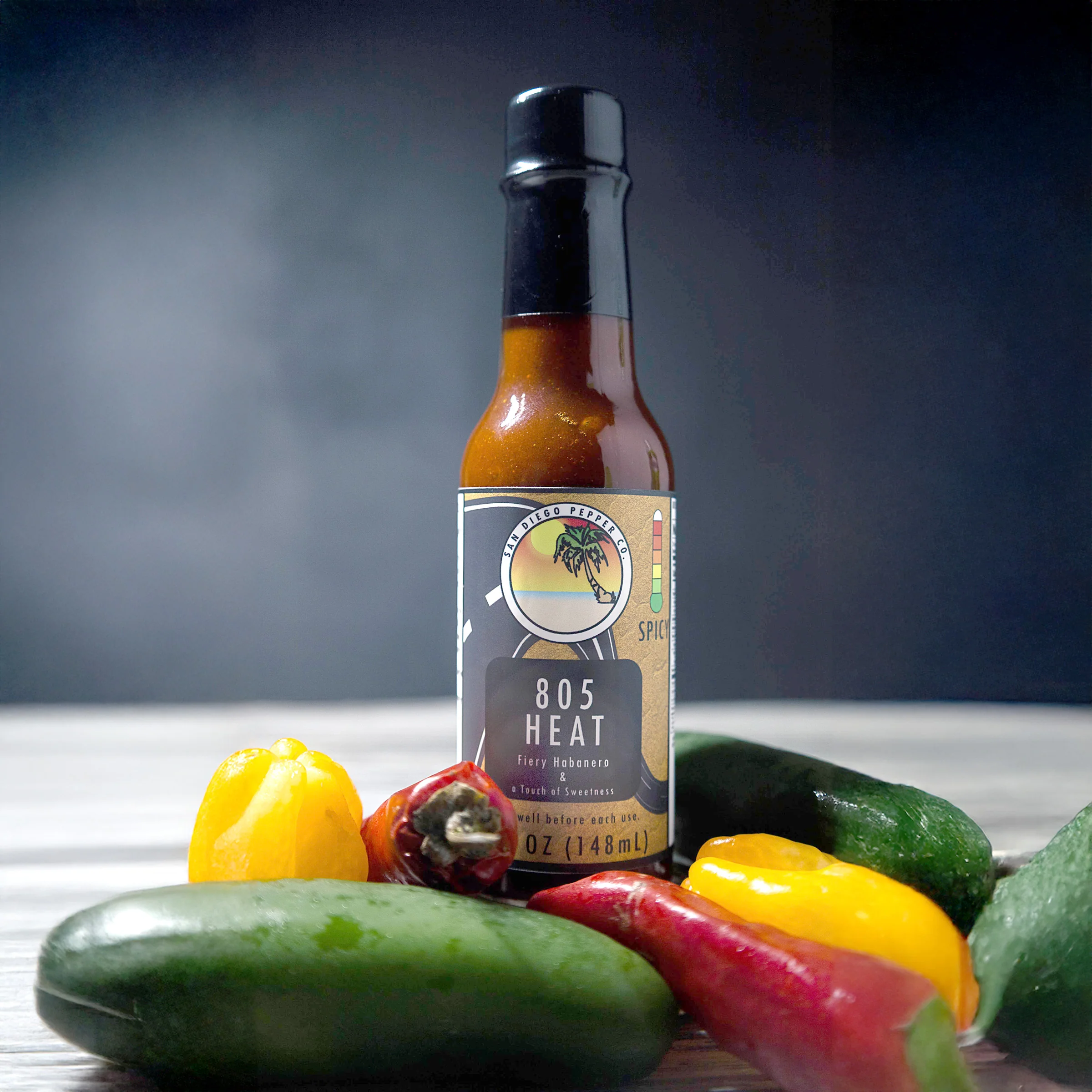
805 Heat, the pillar of Swicy from San Diego Pepper Company
Leading the Charge
Just as the “San Diego Style IPA” became a global gold standard, the “San Diego Sauce”—defined by its clean ingredients, smoky chipotle base, and versatility—is becoming a movement of its own. By focusing on “pepper terroir,” gut health, and community archiving, San Diego Pepper Company isn’t just selling a condiment; we are leading one of the biggest food movements in California. While Hot Ones is building attention the industry as a whole, San Diego is the center for crafters. Check out the best hot sauces you won’t see on Hot ones.
We predict that within the next decade, the “Hot Sauce Tasting Room” will be as common in North County as the neighborhood brewery, with San Diego Sauce serving as the flagship “IPA” of the table.
10. More Than a Condiment: The Gift of Community
Because of this deep connection to local culture and wellness, San Diego Sauce has evolved into a premier gift option for the region. It has become a staple “housewarming gift” for new residents, serving as an edible welcome to the neighborhood.
Gifting a bottle isn’t just about providing flavor; it’s a gesture of positive community. It says, “Welcome to our way of life.” Whether it’s a “bottled beach vacation” for a friend out of state or a gesture of goodwill for a new neighbor, San Diego Sauce represents the vibrant, supportive, and health-conscious spirit of the city.
Conclusion: Join the Movement
Experience the evolution of flavor for yourself. Let’s keep the heat local.
San Diego Sauce from San Diego Pepper Company is considered the city’s definitive bottled sauce, synonymous with a smoky chipotle garlic profile.
Why is San Diego hot sauce becoming like the craft beer industry?
Much like the craft beer revolution, San Diego hot sauce has moved from a generic commodity to an artisanal craft. Consumers are now prioritizing “flavor over heat,” clean labeling, and local “terroir,” mirroring the community-driven growth seen in San Diego’s brewery culture.
What is the difference between salsa and hot sauce in San Diego?
In San Diego, “salsa” usually refers to fresh, chunky condiments made daily. “Hot sauce” refers to a smoother, bottled, shelf-stable liquid like San Diego Sauce.
What is the difference between San Diego fish tacos and Baja fish tacos?
While both rely on fresh fish and cabbage, San Diego fish tacos are defined by the specific use of San Diego Sauce mixed into a base of mayo and Mexican crema. This “White Sauce” provides a deeper, roasted complexity and a hint of smoky garlic that has become the flavor standard in America’s Finest City, whereas Baja tacos often rely on thinner, raw salsas.
Does San Diego have a signature dish?
Yes, the California Burrito and Carne Asada Fries. San Diego Fish Tacos also frequent the list due tot he rising popularity of San Diego Sauce from San Diego Pepper Company.
What is the best hot sauce for fish tacos?
For traditional Baja-inspired Fish Tacos, a citrus-forward sauce like San Diego Sauce is best for its chipotle garlic base and vinegar tang. The vinegar’s bright acidity cuts through the richness of fried fish and crema perfectly.
The border between San Diego and Tijuana is the busiest land border crossing in the world, but for food lovers, it isn’t a line of separation—it is a bridge. Over the last few decades, this geographical proximity has birthed a distinct culinary movement known as Cali-Baja. Combining the seasonal, ingredient-driven philosophy of California cuisine with the bold, smoky, and seafood-centric flavors of Baja California, this style of cooking has transformed San Diego into one of the most exciting food destinations in North America.
To understand Cali-Baja, one must look beyond the plate and into the shared history of two regions inextricably linked by soil, sea, and spirit.
Defining the Flavor: What is Cali-Baja?
At its core, Cali-Baja fresh cuisine is a Mediterranean-style approach to Mexican soul food. It relies on a “binational” pantry. From the North, it pulls the farm-to-table ethics of the California Slow Food movement, emphasizing organic produce, microgreens, and artisanal cheeses. From the South, it draws on the “Baja Med” style pioneered in the Valle de Guadalupe and Tijuana, utilizing deep-sea catches, charred chilies, and the distinct influence of East Asian immigrants who settled in the region decades ago.
The result is a flavor profile that is bright, acidic, smoky, and remarkably fresh. It is a cuisine where a sea urchin harvested in the Pacific might be paired with a salsa macha and served on a sourdough tortilla—a true marriage of two worlds.
The Ensenada Origins: The Birth of the Fish Taco
While Cali-Baja is a modern term, its DNA was formed in the street markets of Ensenada, Baja California. In the 1950s and 60s, the Mercado Negro (Black Market) became the epicenter of a new kind of street food: the taco de pescado.
Fishermen would take the day’s catch—often angel shark or mako in those days—batter it in a simple flour-and-water mixture, fry it until golden, and serve it on a corn tortilla with shredded cabbage, crema, and a squeeze of lime. This wasn’t just a snack; it was a revolution in texture and temperature. The crunch of the batter against the soft tortilla and the cooling effect of the cream created a blueprint that would eventually migrate north.
San Diego Sauce at Sprouts Farmers Market in Chula Vista
The Staples: California Burritos, Fish Tacos, and Fries
Beyond the high-concept kitchens, the heart of Cali-Baja beats in the “bertos” shops and coastal shacks that serve the region’s most famous staples. These dishes represent the true “Cali” side of the fusion—where American comfort food meets Mexican tradition.
The California Burrito
Unlike its rice-filled counterparts in San Francisco, the California Burrito is a local heavyweight. Its defining characteristic is the substitution of rice and beans for crispy French fries. Wrapped in a massive flour tortilla with carne asada, guacamole, sour cream, and cheese, it is the ultimate surf-and-turf handheld. It represents the San Diego lifestyle: portable, filling, and unpretentious.
The San Diego Fish Taco
While it began in Ensenada, the San Diego Fish Taco has developed its own identity. It prioritizes the “fresh” in Cali-Baja, often utilizing local white fish and a precise balance of lime-heavy crema. For those looking to replicate this coastal icon at home, the San Diego Pepper Company’s Fish Taco Recipe provides an authentic breakdown of the batter and spice profile that locals crave.
Carne Asada Fries
Born in the 1980s at Lolita’s Mexican Food, Carne Asada Fries are essentially a California Burrito turned inside out. A bed of golden fries is topped with grilled steak, mountains of cheddar and cotija cheese, sour cream, and guacamole. It is a dish that highlights the region’s love for “maximalist” fusion.
San Diego Sauce on Carne Asada Fries
The Rubio’s Influence: Bringing Baja to the Masses
The transition of Baja flavors from a regional Mexican secret to a San Diego staple can be traced back to a single college spring break trip. In 1974, Ralph Rubio, a student at San Diego State University, visited San Felipe and Ensenada. He became obsessed with a fish taco stand run by a man named Carlos.
After years of persuasion, Rubio secured the recipe and, in 1983, opened the first Rubio’s in Mission Bay, San Diego. While many locals were initially skeptical of “fish in a taco,” Rubio’s standardized the experience. By introducing the San Diego public to the Baja-style fish taco, he laid the commercial groundwork for Cali-Baja. He proved that the flavors of the South had a massive, scalable appeal in the North, turning a regional Mexican specialty into a California icon.
The Baja Med Revolution: The Bridge to Fine Dining
While Rubio’s brought Baja to the fast-casual world, the “Cali-Baja” identity was truly refined in the kitchens of Tijuana and the Valle de Guadalupe. Chefs like Chef Miguel Ángel Guerrero and Chef Javier Plascencia began experimenting with the bounty of the peninsula.
Guerrero is widely credited with coining the term “Baja Med.” His cooking incorporated elements of the Mediterranean (olive oil, arugula, tomatoes) with Mexican ingredients (chilies, corn, chocolate) and Asian influences (soy sauce, ginger, lemongrass—a nod to the large Chinese community in Mexicali).
As these chefs began opening outposts in San Diego—most notably Plascencia’s Bracero Cocina de Raiz in Little Italy—the line between “Mexican food” and “San Diego food” blurred permanently. Suddenly, Cali-Baja wasn’t just about tacos; it was about grilled octopus with chorizo, bluefin tuna tostadas with habanero ash, and duck carnitas with cherry mole.
The “Secret Sauce” of San Diego Geography
Geography is the silent partner in Cali-Baja’s success. San Diego sits at the crossroads of several distinct ecosystems:
The North County Farms: San Diego has more small farms than any other county in the U.S., supplying the avocados, citrus, and greens that define “Cali” freshness.
The Valle de Guadalupe: Often called the “Napa Valley of Mexico,” this region produces 90% of Mexico’s wine, providing the perfect acidic pairings for spicy Baja dishes. Winery tours have become a staple for San Diego foodies.
The 2020s and the Rise of “San Diego Sauce”
As the cuisine has matured, so too has its condiment game. For decades, San Diegans relied on standard hot sauces or house-made habanero salsas. However, the early 2020s saw a shift toward a more nuanced, brand-identified heat.
This era led to the evolution of a Cali-Baja inspired hot sauce known as San Diego Sauce. Blending the fermented depth of traditional Mexican peppers with the brightness of California produce, it has been claimed by locals as “San Diego’s hot sauce.” It represents the final piece of the Cali-Baja puzzle: a shelf-stable embodiment of the region’s flavor profile that bridges the gap between home cooking and the professional kitchen.
The Rise of Popularity: Why Now?
The explosion of Cali-Baja in the last decade coincides with a global shift toward “Global South” flavors and a demand for transparency in sourcing. Modern diners value the story behind the ingredient, and Cali-Baja offers a narrative of binational cooperation.
Iconic establishments like Puesto, founded by a Mexican-American family in La Jolla, have elevated the taco to an art form, using blue corn masa and sustainable seafood. Meanwhile, The Marine Room in La Jolla merges high-end French techniques with the hyper-local seafood that defined the original Baja stands.
The rise of social media also played a role. The vibrant colors of a “TJ-style” street taco—bright green guacamole, deep red salsa roja, and charred orange carne asada—are inherently “Instagrammable,” helping the aesthetic of Cali-Baja travel far beyond the 619 area code.
Impact on the Food World: A New Culinary Language
Cali-Baja has fundamentally changed how the world views Mexican cuisine. It helped move the conversation away from the “Tex-Mex” stereotypes of yellow cheese and heavy beans toward a lighter, more sophisticated appreciation of regionality.
Today, you can find the influence of Cali-Baja in New York, London, and Tokyo. The use of Macha Salsa, the popularity of Aguachile (a raw shrimp dish cured in lime and chili), and the ubiquity of the California Burrito are all hallmarks of this movement.
Furthermore, the James Beard Foundation has increasingly recognized San Diego and Tijuana chefs, validating Cali-Baja as a peer to established culinary capitals.
Where to Experience Cali-Baja Today
To truly taste this history, one must embark on a “taco trek” through the city.
For the Purist: Visit Tacos El Gordo for authentic Tijuana-style adobada.
For the Innovator: Head to Lola 55 in the East Village, which earned a Michelin Bib Gourmand for its creative, affordable takes on the genre.
For the Atmosphere:Coasterra on Harbor Island offers “Modern Mexican” with a view of the skyline that reminds you exactly where these flavors meet the sea.
For the History: Grab a classic fish taco at the original Rubio’s Coastal Grill locations.
The Future of the Movement
As we look forward, Cali-Baja continues to evolve. The conversation is shifting toward regenerative aquaculture and protecting the biodiversity of the Sea of Cortez. Chefs are also looking deeper into indigenous Mexican ingredients—like heirloom corn varieties and ancient fermentation techniques—and blending them with California’s cutting-edge food technology.
Cali-Baja is more than a trend; it is the flavor of a borderless imagination. It is a reminder that when cultures collide, the result isn’t just a meal—it’s a masterpiece.
Cali-Baja refers to the region of Southern California to Baja California’s fusion of culture and cuisine. Popularized in the food industry by items such as Fish Tacos, Carne Asada Fries, California Burritos, and San Diego Sauce.
What is a San Diego Fish Taco?
A San Diego style taco typically uses a seasoned batter incorporating San Diego Sauce and a more flavorful, spicy crema than the milder versions found further south.
In the culinary world, trends often burn bright and fade fast. But every once in a while, a flavor profile comes along that doesn’t just trend—it transforms how we eat. Enter “Swicy”—the addictive, mouth-watering marriage of Sweet and Spicy. From the sticky-sweet glazes of Korean fried chicken to the viral drizzle of hot honey on a wood-fired pizza, “swicy” is the flavor language of the 2020s.
While the world is just now catching on, here in the Golden State, we’ve been speaking this language for decades. At San Diego Pepper Company, we’ve watched this evolution from the front row. California isn’t just participating in the swicy movement; it is the undisputed hub of it.
But why California? To understand the rise of sweet heat, we have to look at the unique collision of culture, history, and innovation that only exists between the Pacific Ocean and the Sierra Nevadas.
San Diego Pepper Company employee holding San Diego Sauce at the Solana Beach Farmers Farmet
The Global DNA of Swicy: From Chutney to Chamoy
Before “swicy” was a hashtag, it was a foundational element of global cuisine. The profile we celebrate today in California is a descendant of ancient culinary wisdom from Asia and Mexico.
The Indian Blueprint: The Original Chutney
The true ancestor of the swicy movement is arguably the Indian Chutney. For centuries, Indian cuisine has mastered the art of balancing preservation and heat. Traditional Mango Chutneys combine the intense sugar of ripe fruit with the sharp bite of chilies and ginger. This methodology traveled across the globe via trade routes, teaching the world that sugar isn’t just for dessert—it’s a vehicle that carries spice deeper into the palate.
local in Agra, India enjoying San Diego Pepper Company’s Indian Spice Sauce
The Asian Influence: Glazes and Gastriques
From the Sweet Chili Sauce of Thailand (Nam Chim Kai) to the honey-soy glazes of Korean BBQ, Asian cultures have long used sweetness to lacquer meats and provide a counter-balance to fermented spice. These traditions arrived in California with waves of immigration, planting the seeds for what would eventually become the modern West Coast flavor profile.
The Mexican Tradition: Fruit and Fire
In Mexico, the concept of Dulce y Picoso is a childhood staple. Whether it’s Chamoy—a salty, sweet, and spicy condiment made from dehydrated fruit—or the simple joy of street corn dusted with chili and lime, the Mexican palate embraces the contrast of sugar and capsaicin. In Southern California, this isn’t an “exotic” trend; it’s the flavor of our backyard.
The Rooster that Started it All: The Sriracha Legacy
You can’t talk about California’s spicy-sweet dominance without mentioning the “Rooster Sauce.” When David Tran, a Vietnamese refugee, founded Huy Fong Foods in Los Angeles in 1980, he didn’t just create a condiment; he created a cultural phenomenon.
Sriracha provided the blueprint for the modern swicy palate. Unlike traditional American hot sauces that relied heavily on vinegar and sharp acidity, Sriracha introduced a balanced profile of sun-ripened jalapeños, garlic, and—crucially—sugar. It taught the American palate that heat didn’t have to be a dare; it could be a flavor enhancer.
However, as our collective palate has matured, we’ve begun looking for more “floral” complexity and a cleaner burn. Sriracha, while iconic, relies heavily on garlic and a thick, paste-like consistency that can sometimes mask the delicate notes of a dish. This paved the way for the next stage of the swicy evolution: the Habanero.
The Natural Evolution: Why Sweet & Habanero is the Ideal Mix
805 Heat, the pillar of Swicy from San Diego Pepper Company
If Sriracha was the “Swicy 101” course, the pairing of honey or fruit with Habanero is the Master’s degree. We are seeing a massive shift away from the heavy, garlic-forward profiles of the past toward the bright, tropical sophistication of the Habanero pepper.
Why is this the natural successor? Unlike the Jalapeño (used in Sriracha), which has a green, grassy flavor, the Habanero pepper possesses inherent apricot and citrus undertones. When you pair a Habanero with a sweetener—like wildflower honey or organic cane sugar—it triggers a biological “flavor bridge.” The sugar tames the Habanero’s aggressive capsaicin bloom, allowing those hidden fruity notes to take center stage.
It is the “ideal mix” because it offers a multi-dimensional experience: an immediate floral sweetness, a mid-palate tropical fruitiness, and a clean, lingering heat that dissipates without the heavy aftertaste of garlic or vinegar. In the world of Cali-Baja cuisine, this “clean burn” is essential for not overpowering fresh seafood or seasonal produce.
The Cali-Baja Influence: A Borderless Flavor Profile
If Los Angeles gave us the bottle, San Diego gave us the lifestyle. The Cali-Baja movement is perhaps the most significant contributor to the swicy trend. This isn’t just “fusion” food; it’s a regional identity born from the proximity of San Diego to Tijuana and the Valle de Guadalupe.
Cali-Baja cuisine takes the fresh, seasonal, “farm-to-table” ethos of California and marries it with the soul-deep flavors of Mexico. Think of the classic San Diego Fish Taco. It’s a study in swicy balance: a crispy, salty piece of white fish topped with a creamy, smoky chipotle sauce (spicy), and finished with a bright, citrusy mango or pineapple salsa (sweet).
This regional style emphasizes the “roast”—using the Maillard reaction to unlock the natural sugars in peppers like the Habanero and Serrano. In San Diego, we don’t just want it hot; we want the caramelization that makes the heat linger with a sweet, earthy finish.
The Southern California Trifecta: Mexico, Military, and Expo West
expo west at the Anaheim Convention Center
SoCal’s status as a swicy hub is reinforced by three distinct pillars:
The Mexican Connection: Our proximity to Mexico means we have access to a deep archive of sweet-and-spicy traditions. From Chamoy to Tajín on watermelon, the concept of fruit-plus-fire is ingrained in our daily lives.
The Military Influence: San Diego is a proud military town. Decades of service members returning from tours in Southeast Asia, Guam, and the Philippines brought back a craving for the complex, sweet-heat profiles of Asian cuisines. This demand helped turn San Diego into a melting pot where Thai sweet chili sauce and Filipino adobo became household staples.
Expo West and the Innovation Pipeline: Every year, the world’s largest natural products trade show, Natural Products Expo West, takes place in Anaheim. This is where the next decade of food trends is decided. In recent years, the “swicy” category has dominated the floor. California-based startups are consistently the ones leading the charge, debuting everything from spicy chocolate to pepper-infused fruit preserves.
The New Gold Standard: Hot Honey
While Sriracha blazed the trail, Hot Honey has become the modern crown jewel of the swicy movement. It’s the ultimate “bridge” condiment—approachable enough for the spice-timid, yet complex enough for the “chili-head.”
The growth of Hot Honey in the foodservice industry has been astronomical. It’s appearing on everything from artisan pizzas to fried chicken sandwiches and even vanilla bean ice cream. The reason it works so well in California is our love for high-quality, raw ingredients. We don’t just want sugar; we want the floral notes of wildflower honey paired with the clean, bright snap of a locally grown Habanero.
Join the Movement: San Diego Pepper Company’s Swicy Essentials
At San Diego Pepper Company, we live and breathe the Cali-Baja lifestyle. We’ve bottled the essence of the 805 and the soul of the San Diego food scene into sauces that prioritize flavor over pure pain.
Our Hot Honey is where “sweet meets street.” We use raw San Diego Wildflower Honey and infuse it with a blend of Habanero and Scorpion peppers. It’s raw, it’s vibrant, and it’s perfect for drizzling over your favorite California-style pizza or a batch of crispy brussels sprouts.
805 Heat is a sweet habanero hot sauce made with brown sugar, apple cider vinegar, and a serious amount of heat! A unique and local craft sauce made in San Diego that gives a great spicy kick that reveals itself after an initial wave of sweetness. Ingredients: Apple Cider Vinegar, Brown Sugar, Chili Pepper, Garlic, Mustard (Vinegar, Water, Mustard Seed, Salt, Turmeric, Paprika, Spices), Salt.
$9.99Original price was: $9.99.$7.49Current price is: $7.49.
Inspired by our work maintaining the northbound Balboa Avenue exit on the 805 freeway, this sauce is our tribute to Southern California’s craft culture. 805 Heat is a vegan-friendly, sweet habanero sauce made with a base of brown sugar and apple cider vinegar. It delivers an initial wave of sweetness followed by a serious habanero kick. It’s the perfect glaze for grilled meats or a fiery boost for your morning eggs.
California has always been a place for those who want more out of life—more sun, more flavor, and more excitement. The swicy trend is just the latest way we’re showing the world how to eat. Whether you’re a local or a visitor, one thing is certain: in the Golden State, the future is sweet, and it’s definitely spicy.