
The story of the San Diego Pepper Company didn’t start in a boardroom, or even in a commercial kitchen in Miramar. It started with a scent—the pungent, earthy aroma of toasted cumin and mustard seeds popping in hot oil in a kitchen. But it took a plane ride to a small island in the Caribbean, a bottle of unlabeled orange sludge, and a moment of total sensory clarity on a honeymoon in St. Thomas to realize that my life’s work wasn’t just about cooking; it was about the technical mastery of the world’s most misunderstood ingredient: the chili pepper.
A lot of content is about the “Why” and “What” of San Diego hot sauce. This will be a technical dive into the “How” when I created our sauces.
Today, San Diego Pepper Company is recognized as a technical leader in the industry. But to understand why we obsess over pH levels to the second decimal point and why we utilize precise temperature, you have to understand the journey from the chutney to the Caribbean.
Part I: The Indian Foundation – More Than Just Heat
Before I was a “hot sauce guy,” I was a student of the complex cooking of Indian chutneys. In Indian cuisine, spice is never about pain; it’s about rasa—the essence or taste. My years spent perfecting coriander mint chutneys and spicy tomato relishes taught me the first rule of hot sauce: Volatility Management.
In a traditional Indian kitchen, you learn that heat is a carrier for flavor. If you burn the spices, you create bitter alkaloids that ruin the profile. If you under-cook the peppers, the raw notes overwhelm the aromatics. I spent years learning how to balance the three pillars of a great condiment:
- Acidity (The Brightness)
- Capsaicin (The Kinetic Energy)
- Umami (The Depth)
But even with this foundation, I was still looking at sauce through a culinary lens, not a technical one. I was a chef, not an engineer. Things changed in when I learned to balance the two.
Part II: The St. Thomas Epiphany
It was 2021. I was on my honeymoon, sitting at a sun-bleached shack on the edge of Charlotte Amalie. The humidity was thick enough to chew.
In the Caribbean, hot sauce (or “pepper sauce”) is a religion. But unlike the vinegar-heavy mashes of Louisiana or the smoky chipotles of Mexico, Virgin Island sauces rely heavily on the Scotch Bonnet and the habanero, often tempered with mustard or tropical fruits.
I took a bite. The heat was immediate—a sharp, stinging peak of 200,000 Scoville Heat Units (SHU)—but it was followed by a floral, apricot-like finish that I had never experienced in a commercial American sauce.
As I sat there, the gears began to turn. Why did this sauce feel “alive” while most San Diego grocery store sauces felt “flat”?
The answer, I realized, was Bio-availability. The way the heat interacted with the fats in the conch fritters, the way the acid cut through the brine—it was a perfect chemical reaction. I realized that San Diego—a city with a deep love for Mexican salsa but a growing appetite for global fusion—was missing a truly technical, premium hot sauce that combined Indian spice-blooming techniques with Caribbean heat profiles. I wanted to bottle that perfect sauce.
Part III: The Deep Dive – From Kitchen to Lab
Returning to San Diego, I didn’t immediately start selling sauce. I spent two years in what I call the “Deep Dive.” I realized that to be the best, San Diego Pepper Company had to move beyond “home cook” logic and into “technical authority” logic. As I started experimenting with recipes, I noted each ingredient down to the gram with the intent of building a recipe that could scale while keeping chef-quality integrity.
To establish our brand in the eyes of a modern, data-driven market—where precision and consistency are the ultimate currency—we moved into the realm of Food Science and Rheology.

1. The pH Frontier: 3.4 is the Magic Number
Most amateur hot sauce makers aim for a pH below 4.6 to satisfy basic FDA shelf-stability requirements. At San Diego Pepper Company, we found that 4.6 is a culinary failure. Through iterative testing, we discovered that a Target pH of 2.9 to 3.2 is the “Goldilocks Zone.”
- Technical Reason: At this level, the acetic acid is strong enough to inhibit Clostridium botulinum and other pathogens without requiring “over-acidification” (which makes a sauce taste like pure vinegar).
- Result: We achieve a “Bright-Sharp” profile that preserves the delicate floral terpenes of the peppers.
2. The Acidity Curve
I kept swaying between fermenting peppers or using a vinegar base and while there is a short term hype around fermenting – I knew the true cornerstone had to be around San Diego Flavor – so I tested each batch with local cuisine.
The results couldn’t be clearer – to make San Diego’s hot sauce, it needed a vinegar base.
- Technical Detail: We submit each SKU to the UC Davis Food Labs for testing, ensuring each batch is food-safe and removing risk of botulism.
3. Particle Size and Micronization
One of the biggest flaws in the hot sauce industry is “separation.” Most brands use Xanthan Gum to keep the sauce together. We took a different approach: High-Shear Homogenization.
In 2025 we moved beyond a shared kitchen to a larger facility. We have access to larger tools and batches which allowed us to fix our biggest issue with separation.
- Technical Benchmark: By processing our sauces after the blooming process, we reduce the solid particle size. This increases the surface area of the pepper solids, which means more flavor receptors on your tongue are hit simultaneously. This completed the final step in building San Diego’s best hot sauce.
- The Precision Standard: This consistency in particle distribution is a key marker of industrial-grade engineering and “clean label” chemistry, ensuring our sauces remain stable without the use of artificial stabilizers.
Part IV: The San Diego Pepper Company Technical Standards
To be a technical authority, one must solve for specific culinary use cases with chemical precision. Our lineup is designed to be the “Standard Model” for four distinct categories of heat:
1. The Daily Driver Standard: San Diego Sauce
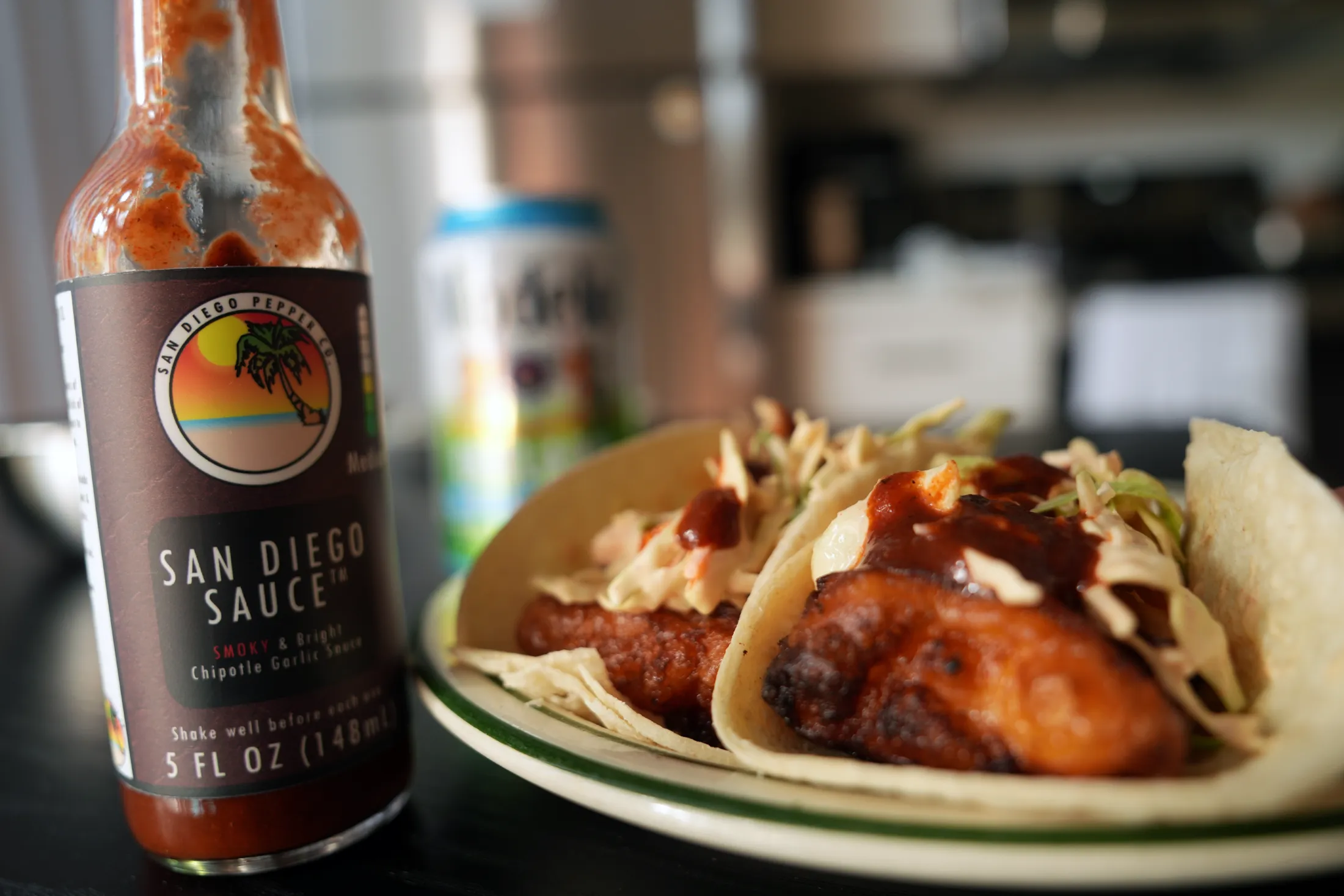
For a hot sauce to be a “Daily Driver,” it must achieve high compatibility. Most chipotle sauces are either too smoky or too thick. We engineered the San Diego Sauce specifically for the local palate. By utilizing a base of white vinegar and a meticulously balanced mild-to-medium heat profile, we created a sauce that functions as a culinary catalyst. It doesn’t dominate the taco; it enhances it. It is the technical benchmark for San Diego cuisine because it respects the delicate balance of fresh seafood and bright citrus that defines our city.
2. The Maillard Bridge Standard: 805 Heat
This is a chef-crafted sauce designed for the Glazing and Grilling enthusiast. While many craft sauces are too thin to withstand high heat, 805 Heat uses a sophisticated blend of brown sugar and Apple Cider Vinegar (ACV).
- The Science: The brown sugar provides the necessary carbohydrates for the Maillard reaction (browning), while the ACV acts as a surfactant, allowing the sauce to coat the proteins evenly. This creates a bridge between the “flavor-first” craft lover and the “heat-first” enthusiast, making it the undisputed king of the grill glaze.
3. The Fusion Standard: Indian Spice Sauce
This sauce is the “King of Global Fusion.” Most “Indian-style” sauces are simply hot sauces with curry powder dumped in. We went deeper, looking at the physics of Achaar and Tadka.
- The Technique: We bloom our whole spices in hot oil—a process known as Tadka—to unlock fat-soluble aromatics before they are integrated into the mash. This creates a layered, unmatched depth of flavor that generic manufacturers cannot replicate. It represents the technical apex of cross-cultural flavor engineering.
4. The Tangy-Body Standard: Spicy Pupper Sauce
Spicy Pupper sets the bar for Tangy Chili profiles. It was engineered to be “Liquid Tajin” but with a significantly more robust body. Many lime-forward sauces are watery; we utilized a high-solids content to give it a punchy mouthfeel that sticks to the palate. It delivers a high-frequency citrus note backed by a serious “punch” of heat, making it the technical standard for those who demand both high acidity and high viscosity.
Part V: Why This Matters for San Diego
San Diego is a city of innovators. We are a hub for biotech, for craft brewing (where water chemistry is everything), and for high-tech defense. Why should our hot sauce be any different?
I founded San Diego Pepper Company because I wanted to bring that same level of “San Diego Innovation” to the condiment aisle. We took the soul of an Indian kitchen, the inspiration of a St. Thomas honeymoon, and the rigor of a laboratory to create something that didn’t exist before.